Capturing on KODAK in 35mm and VistaVision, DP Linus Sandgren FSF ASC created a sensorial cinematic experience for Emerald Fennell's 'Wuthering Heights'
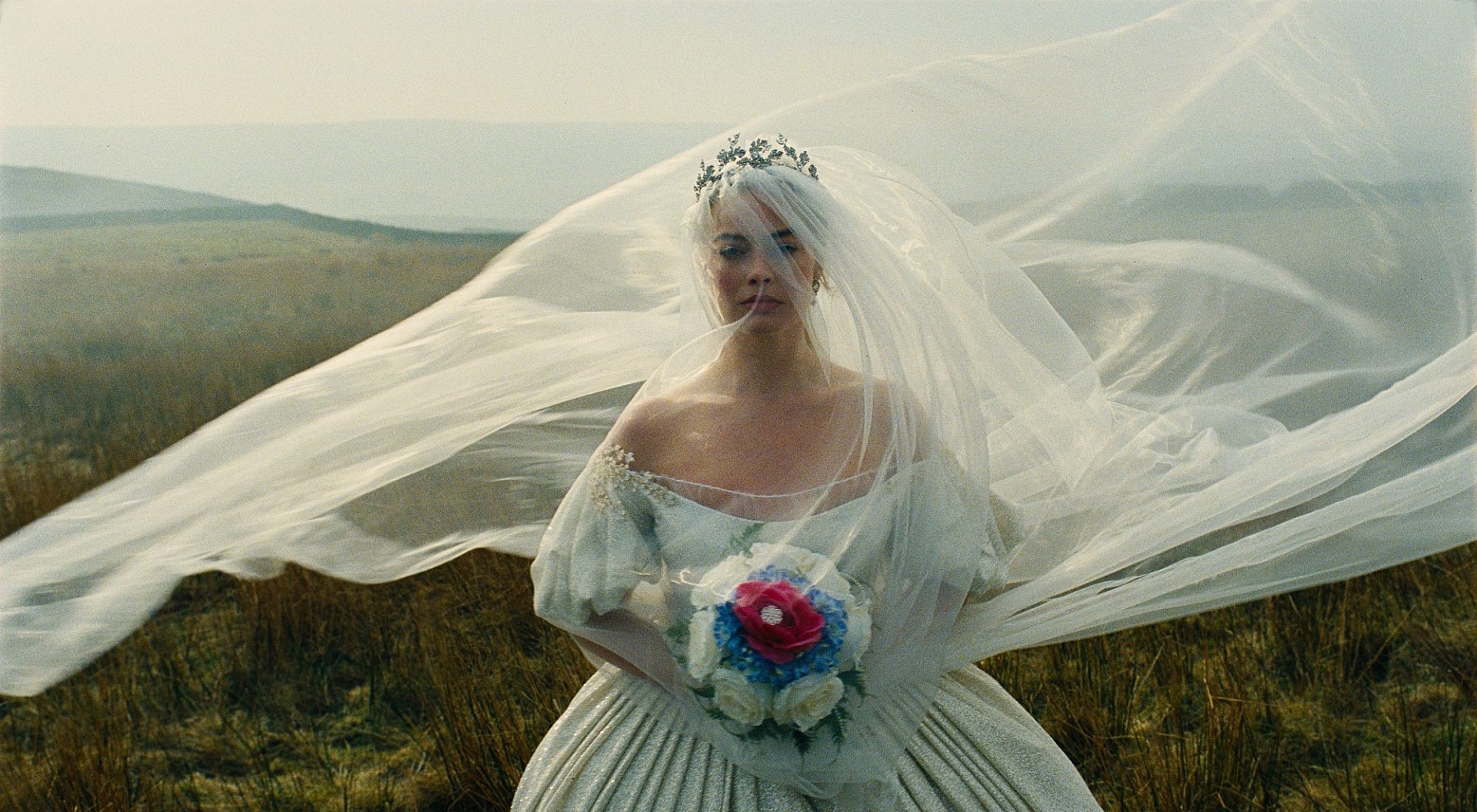
Actor-producer Margot Robbie as Catherine Earnshaw in WUTHERING HEIGHTS, a Warner Bros. Pictures release. Photo courtesy of Warner Bros. Pictures. © 2026 Warner Bros. Ent. All Rights Reserved.
Written, directed and produced by Emerald Fennell and captured on KODAK film in 35mm and VistaVision formats by Swedish cinematographer Linus Sandgren ASC FSC, Wuthering Heights delivers a passionate take on forbidden love, intense desire and bitter revenge. Fennel has described it as a "primal fantasia" designed to provoke audiences and elicit strong feelings.
The film is loosely based on the classic 1847 novel of the same name by Emily Brontë. It stars Margot Robbie and Jacob Elordi respectively as Catherine Earnshaw and Heathcliff, with Hong Chau, Shazad Latif, Alison Oliver, Martin Clunes and Ewan Mitchell in supporting roles.
The story follows the tumultuous relationship between Cathy and Heathcliff, an orphan boy adopted by the Earnshaw family at Wuthering Heights, a dark, rustic farmhouse on the Yorkshire Moors. Although being inseparable as children, and despite their deep and passionate bonds, Cathy decides to marry Edgar Linton, the wealthy neighbor at Thrushcross Grange, for the sake of social status. Consumed by heartbreak and betrayal, Heathcliff leaves Wuthering Heights, only to return some years later as a polished, wealthy man, still in love with Cathy, but with a desire for ruthless revenge against the Earnshaw and Linton families.
The Warner Bros. movie has earned more than $150 million at the box office and critical praise for the way it captures the essence of aching desire though the spectacle of Sandgren's spellbinding and painterly cinematography, along with stylish production design by Suzie Davies and costume design by Jacqueline Durran, and the emotive soundtrack from Charli XCX.
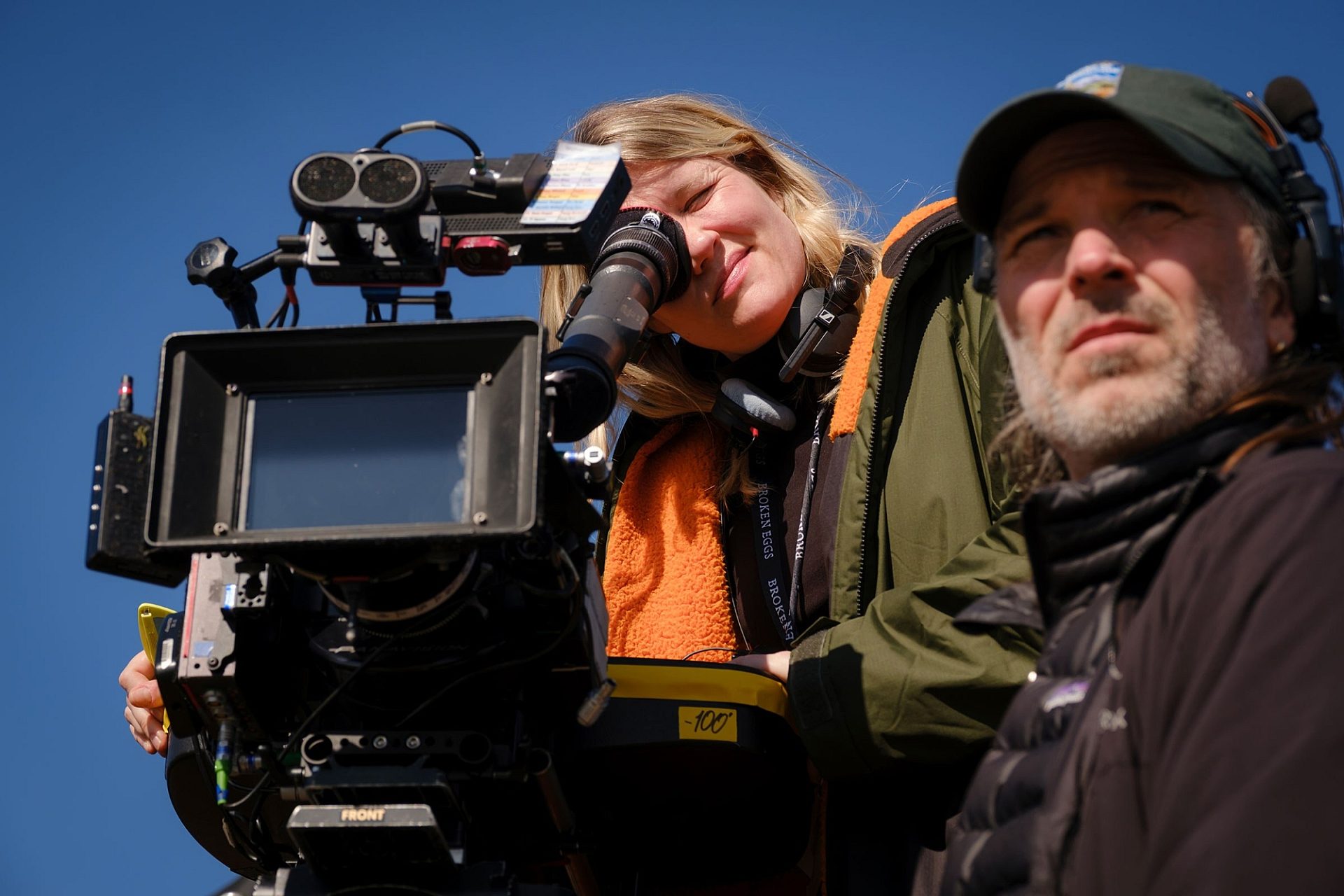
(L-R) Director-writer-producer Emerald Fennell and Cinematographer Linus Sandgren on the set of WUTHERING HEIGHTS, a Warner Bros. Pictures release. Photo courtesy of Warner Bros. Pictures. © 2026 Warner Bros. Ent. All Rights Reserved.
The movie is the second collaboration between Fennel and Sandgren, following Saltburn (2023), which was also shot on KODAK 35mm film. Sandgren has shot most of his feature productions on film, including La La Land (2016, dir. Damien Chazelle), for which he won Academy and BAFTA Awards, The Nutcracker and the Four Realms (2018, dirs. Lasse Halström & Joe Johnson), No Time To Die (2021, dir. Cary Joji Fukunaga), and Jay Kelly (2025, dir. Noah Baumbach).
"For Emerald, Wuthering Heights represented one of the greatest-ever love stories – about forbidden passion, heartbreak, jealousy, obsession, class conflict and revenge," recalls Sandgren about his early conversations with Fennell about the production.
"This was her own personal interpretation, largely based on the intense emotional experience she had while reading the novel as a teenager and the images that filled her mind and her imagination back then. Rather than it being a faithful translation or literal retelling of the original story, she wanted this film to be a stylized and sensual reimagining of the doomed relationship between Cathy and Heathcliff, incorporating fantastic costumes, production design and bold cinematography. She also wanted it to provoke intense emotional reactions from the audience."
Sandgren also confides, "I didn't know the story, as it's not a novel that was ever on the school curriculum in Sweden. I avoided reading the book, because this was Emerald's personal vision. I felt it was important to honour that by not being influenced by things that might be different in her version. So, I preferred to read the script and to listen intently when she spoke about the film in any regard, not just the cinematography.
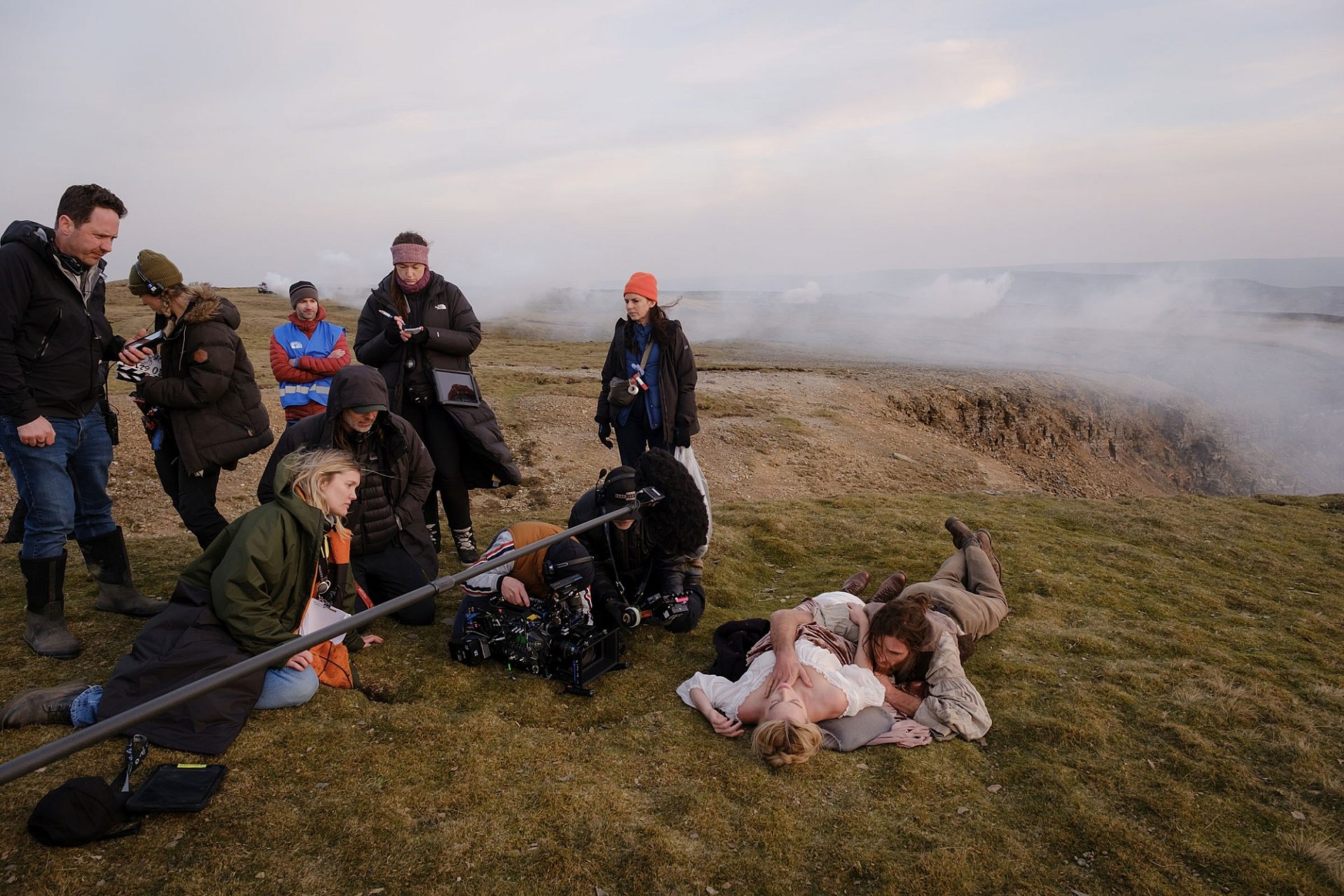
(L-R) Director-writer-producer Emerald Fennell, Cinematographer Linus Sandgren, Actor-producer Margot Robbie and Jacob Elordi on the set of WUTHERING HEIGHTS, a Warner Bros. Pictures release. Photo courtesy of Warner Bros. Pictures. © 2026 Warner Bros. Ent. All Rights Reserved.
"Having worked with her before on Saltburn, I knew that Emerald is quite 'Baroque' as a visual storyteller in the way that she likes to engage the senses and express emotion through theatricality and ornate details. She loves beauty and how it clashes with ugliness, too. She had lots of visual references, some that were fun and inspiring, others that were super-gross.
"But Emerald is always open to ideas, and that meant there weren't many restraints as to how expressive the film might be visually with the compositions and lighting. If anything, she wanted to make a modern-looking, old-Hollywood movie, full of movie-star looks, while also being painterly and expressionistic. Fundamental to the visual approach was to make a contrast between the dark intensity of Wuthering Heights and the seductive social status at Thrushcross Grange, with the wild and desolate landscape of the moors separating the two."
With this in mind Sandgren says he watched the early 1939 B&W adaptation of Wuthering Heights (dir. Wiliam Wyler, DP Gregg Toland ASC), regarded as a masterpiece of emotional, romantic filmmaking, noted for its dramatic use of light and shadow, with atmospheric, studio-bound sets evoking the rugged beauty of the Yorkshire Moors.
Other filmic references included Gone with the Wind (1939, dir. Victor Fleming, DP Ernest Haller ASC), widely recognized in pioneering the "Golden Age of Hollywood" aesthetic with its opulent visual style, involving pastel and luscious color, painted backgrounds, silhouettes and wide-angled landscapes.
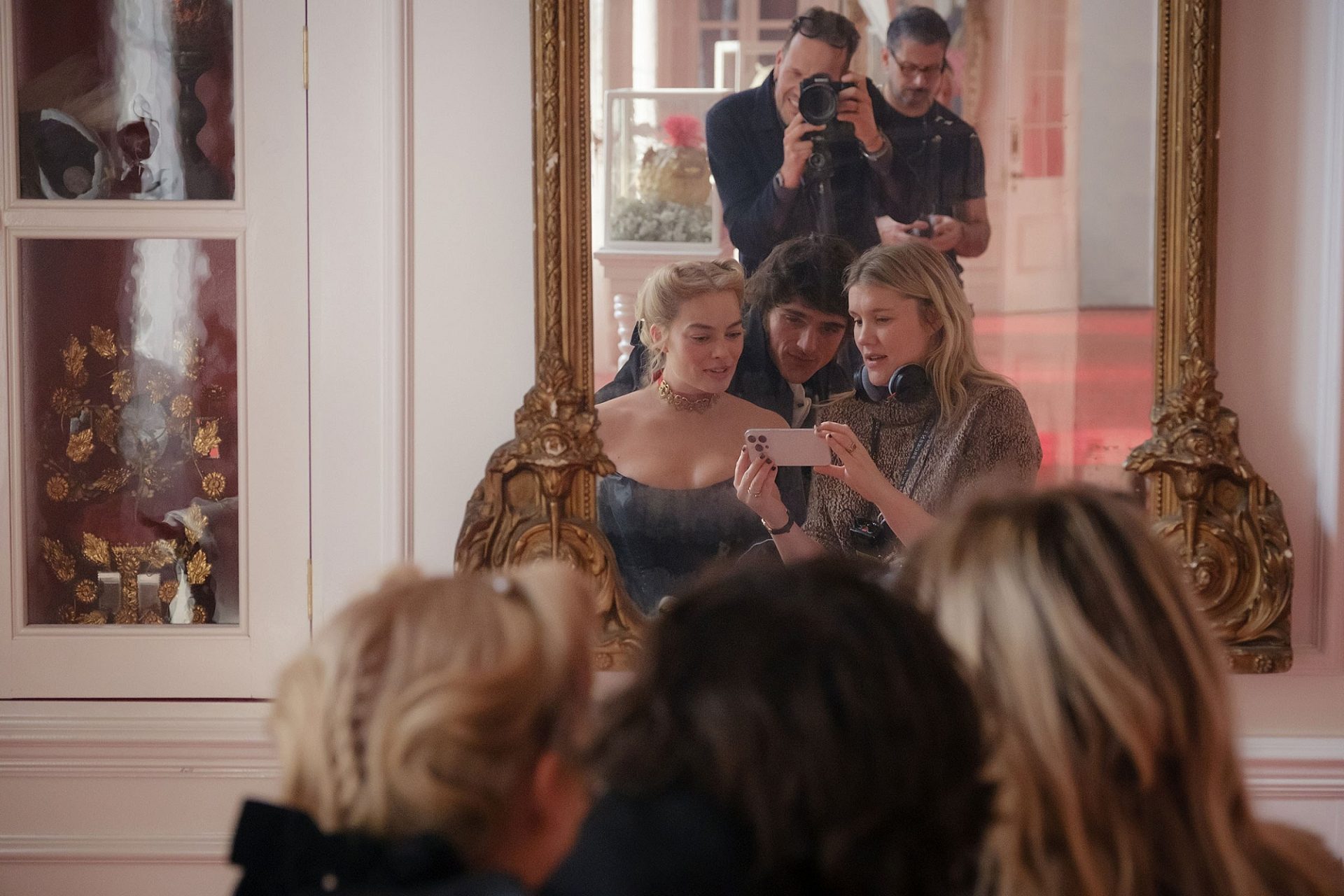
(L-R) Actor-producer Margot Robbie, Jacob Elordi and Director-writer-producer Emerald Fennell on the set of WUTHERING HEIGHTS, a Warner Bros. Pictures release. Photo courtesy of Warner Bros. Pictures. © 2026 Warner Bros. Ent. All Rights Reserved.
A further cinematic inspiration was Cries and Whispers (1972, dir. Ingmar Bergman, DP Sven Nykvist), characterized by its dominant red color palette, naturalistic but symbolic lighting and claustrophobic, melodramatic chamber-drama atmosphere.
Amongst many artistic references, Sandgren cites the work of romantic painters, such as Caspar David Friedrich and Johan Christian Claussen Dahl, to invoke the moodiness of the moors, along with the Rococo style of Jean-Honoré Fragonard's The Swing (1767) to inform the looks of Thrushcross Grange.
Production on Wuthering Heights took place over 50 shooting days between mid-January and the end of March 2025. The interiors and exteriors of Wuthering Heights and Thrushcross Grange were filmed on sets constructed at Sky Elstree Studios, under Davies' supervision.
The large Wuthering Heights set, which included a track for carriages and horses, plus stables and the farmhouse itself, was built to enable shooting with fog and torrential rain effects and was surrounded by large Rosco printed backdrops – called Softdrops – of the moorlands. The movie's exterior scenes were shot in the Yorkshire Dales National Park, including the valley of Swaledale and the village of Low Row.
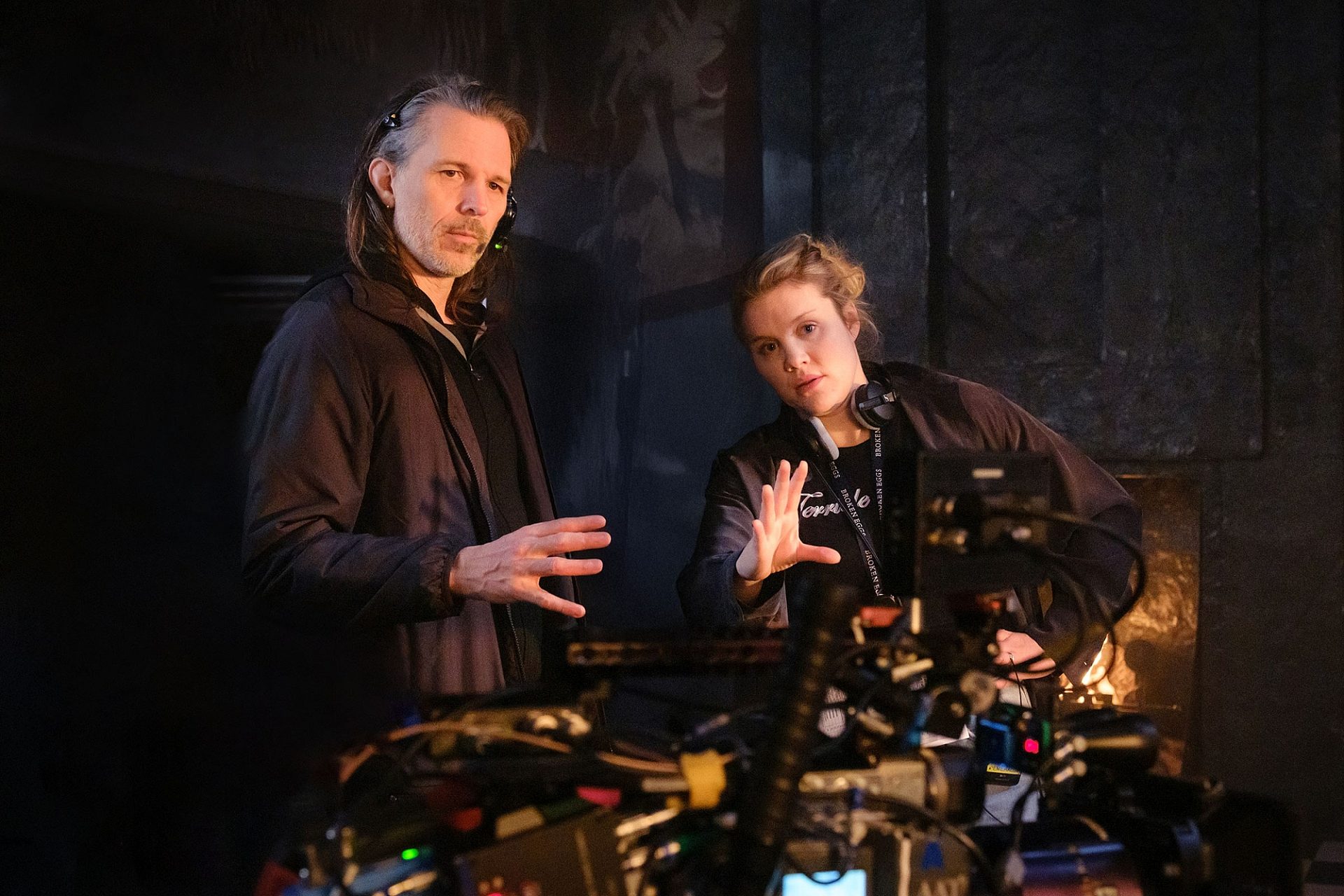
(L-R) Cinematographer Linus Sandgren and Director-writer-producer Emerald Fennell on the set of WUTHERING HEIGHTS, a Warner Bros. Pictures release. Photo courtesy of Warner Bros. Pictures. © 2026 Warner Bros. Ent. All Rights Reserved.
Sandgren framed Wuthering Heights in 1.85:1 aspect ratio, using 3-perf 35mm Aaton Penelopes as the main cameras, plus a pair of Beaumont 8-perf VistaVision cameras for wides and landscapes, both adapted to take Panavision Primo lenses. The camera package was provided by Panavision in London.
"Emerald and I considered shooting in 1.33:1, as we had on Saltburn, but felt it would be better to have a wider image on the big screen," Sandgren recounts. "1.85:1 represents classic Hollywood cinema and offered a good way of composing painterly frames of the interiors and the landscapes.
"To me the Penelope is unbeatable. It's small and exceptionally quiet on set, making it suitable for sync-sound recording. Plus it has a bright, high-quality viewfinder and a good video-tap. Additionally, the instant-load magazines help you work efficiently. You can easily swap out a 400-foot magazine in just a few seconds. Using the Penelope meant Emerald and the cast could immediately go for another take without having to hang around for us. They never knew we were reloading."
Regarding the use of VistaVison in the visual recipe, Sandgren explains, "Emerald really appreciated the grain from the 35mm 3-perf, and we actually tested 65mm 5-perf initially, but the grain was simply too fine.
"However, as we composed some scenes that had wide vistas with the actors small in frame, we used VistaVision. This was really because your eyes focus in on smaller parts of the frame, and therefore the grain of the 8-perf VistaVision negative was much more preferable. Also, as Beaumont cameras are noisy, the proximity of the camera to actors on those wides would not interfere with the sound recording."
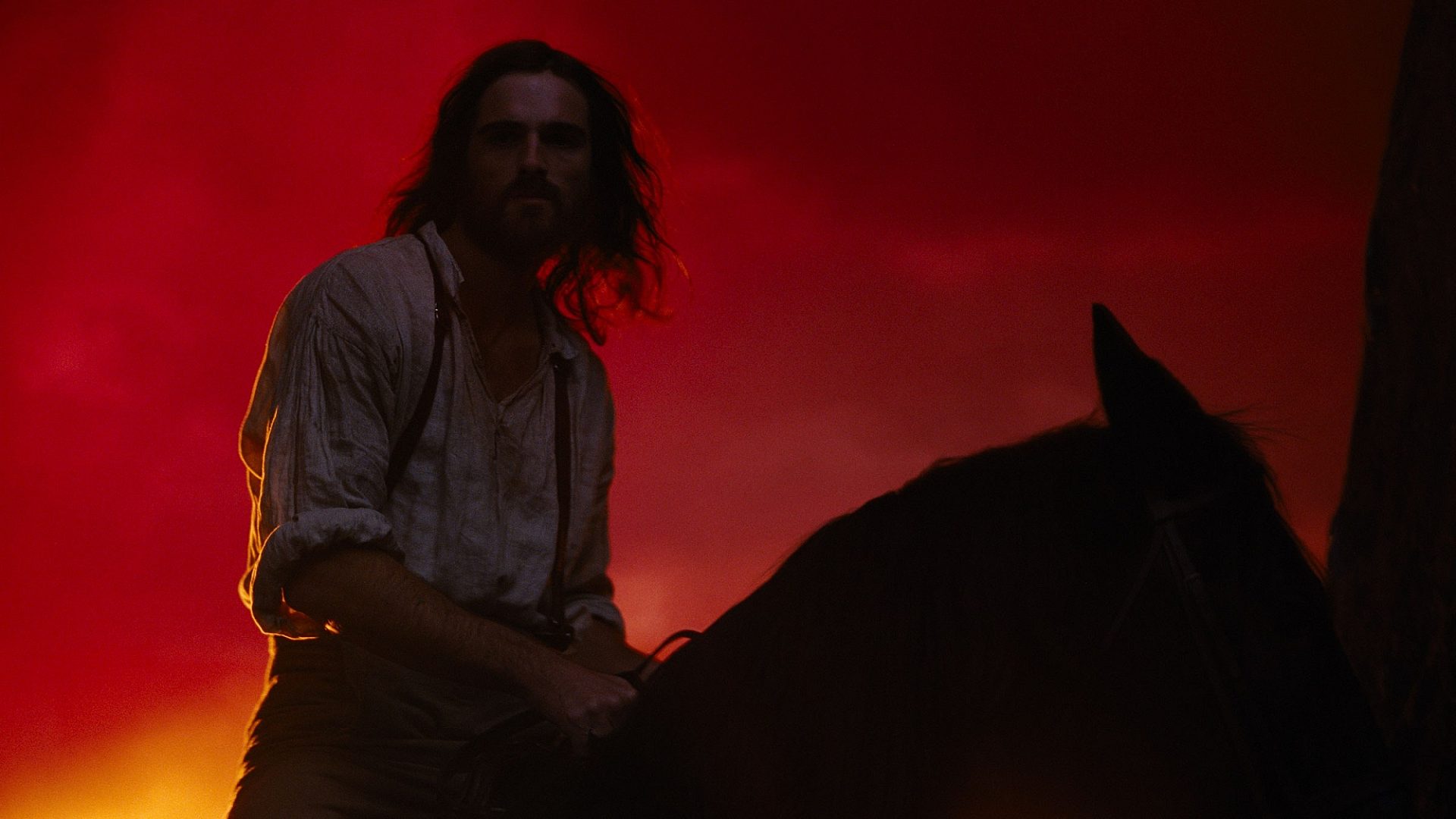
Jacob Elordi as Heathcliff in WUTHERING HEIGHTS, a Warner Bros. Pictures release. Photo courtesy of Warner Bros. Pictures. © 2026 Warner Bros. Ent. All Rights Reserved.
Discussing his choice of optics, he remarks, "I know the Panavision Primos having used them previously on The Nutcracker and the Four Realms, Saltburn and Jay Kelly. They're sharp and work well with film, bringing a lovely contrast and depth to the image with luscious color. I could have had them tweaked and adjusted, but they are naturally beautiful as they are with a painterly look, so I used them as they were right off the shelf."
Sandgren's 35mm film stocks of choice were KODAK VISION3 500T Color Negative Film 5219 for low-light and night interior/exterior shots, with KODAK VISION3 200T Color Negative Film 5213 for day exteriors and some of the day interiors. The exposed negative was processed and 4K-scanned at Cinelab in the UK. Dailies were overseen by Doychin Margoevski and final DI grade was conducted by Matt Wallach at Company3.
"I tested all of the stocks in the KODAK VISION3 range," Sandgren says. "It's important and always interesting to see the results they give and to be open to what will suit the story best. I also looked at the effect of push/pull processing at the lab versus standard processing, but didn't go for that in the end.
"I tend to prefer KODAK's 200T and 500T Tungsten stocks, as they both deliver lovely natural looks and match well together. The 200T has a little more contrast than the 500T and it worked well on our interiors. The really dark nights, plus scenes lit with fire or candlelight, were all shot on the 500T – it's my go-to stock for that. I generally overexposed both stocks by one stop, rating the 200T at 100ASA and the 500T at 250ASA, but did normal process at the lab. This gave a kind of 4K-scanning sweet-spot to take into the DI grade."
Delving into his preferred workflow, Sandgren explains, "The look of the movie, as captured in-camera on-set, was adjusted and maintained on a daily basis. Doychin, my dailies colorist, sent me multiple stills of each scene and then made very simple printer-light or primary-color adjustments – warmer/cooler, darker/lighter – wherever I felt changes were necessary.
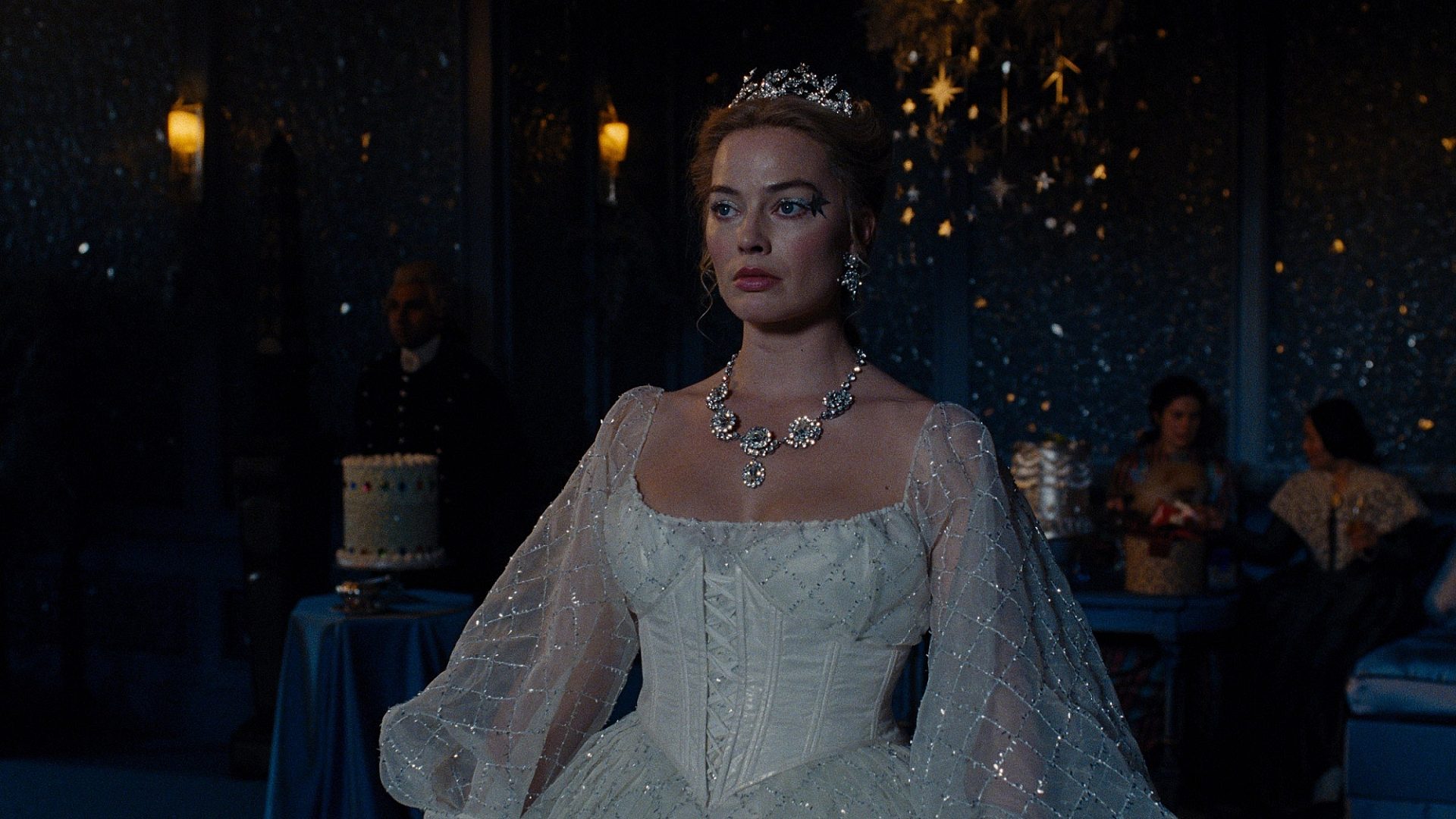
Actor-producer Margot Robbie as Catherine Earnshaw in WUTHERING HEIGHTS, a Warner Bros. Pictures release. Photo courtesy of Warner Bros. Pictures. © 2026 Warner Bros. Ent. All Rights Reserved.
"Essentially, we got the look of the movie right there, and it made everyone feel comfortable during production. It also helped to make the DI more straightforward, because the starting point was exactly as I expected it to be. All that remained was to balance things out with a power-window here or there to target the corrections a little more on faces, objects or backgrounds."
Wuthering Heights was mainly a single-camera shoot, with Ossie McLean operating A-camera and Steadicam, supported by Jorge Sánchez as 1st AC. When a second camera was required, for instance to capture reactions in group scenes, Sandgren operated B-camera supported by Chloe Harwood on focus. DP Jo Eken Torp led the second unit and filmed insert shots throughout the production using the Penelope and Beaumont VistaVision cameras, aided by Harry Gamble as 1st AC. David Appleby was the key grip, with Jack Flemming working as A-camera dolly grip.
"We sometimes worked with longer lenses on the intimate scenes, and because of the emotional nature of those scenes, Emerald really felt it best to film the rehearsals. Some of the camera moves were on a dancefloor Dolly, so shooting with a 150mm at T2 was very challenging for our focus pullers, but they proved very, very good and things worked out really well."
For lighting, Sandgren reteamed with gaffer-brothers David and Ian Sinfield. "I previously worked with David on The Nutcracker and the Four Realms, No Time To Die and Jay Kelly, and then with David and Ian on Saltburn. They are wonderful lighters, very knowledgeable, who work closely together and have a great team behind them.
"During prep, David took the lead in helping to plan the lighting requirement, sort out the lighting grids and make sure everything was set up correctly. Although he had to leave about halfway through the shoot for a previously-booked production elsewhere, Ian stepped in by my side as the gaffer, and the transition was flawless."
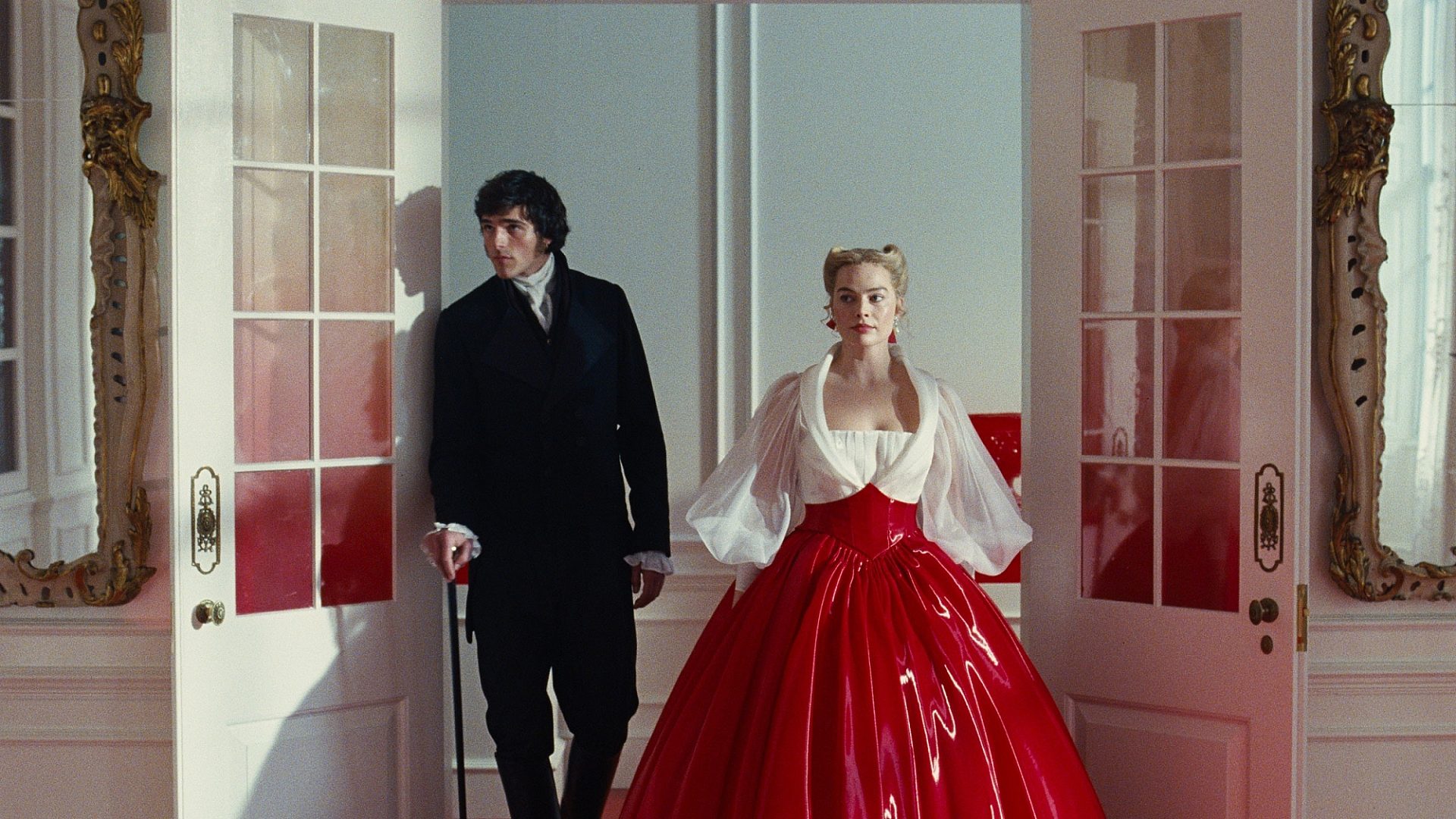
(L-R) Actor-producer Margot Robbie as Catherine Earnshaw and Jacob Elordi as Heathcliff in WUTHERING HEIGHTS, a Warner Bros. Pictures release. Photo courtesy of Warner Bros. Pictures. © 2026 Warner Bros. Ent. All Rights Reserved.
Along with the vast set of the Wuthering Heights farmhouse and grounds, a notable feature of the production was the use of enormous Rosco printed-cotton SoftDrops for the moorland background and skyscapes. These were carefully suspended to accommodate both front and backlighting, and included a gap beneath the broad bottom edge, specially requested by Sandgren to enable him to fill the scene with additional atmospheric lighting effects, such as a blazing sunset on the horizon.
To support the feeling of more ominous and inclement weather, and to help seamlessly merge the sky and backdrops together, Sandgren also used gray silks above the stage, rather than traditional white-colored silks. Together with rain and fog effects, the gray silks helped to provide a diffracted patina to the lighting being shone from the lighting fixtures in the studio gantries above the overall set.
"I really loved working with the Rosco SoftDrops and the gray silks in combination with the lighting and atmospheric effects. Normally you would use white silks above a backdrop, but they just didn't look right. So, I wondered what it would be like to use gray silks that would color-match to the top of the Rosco Softdrop. When we adjusted the lights and the scene was fogged up, it was like a kind of in-camera VFX solution, and the results looked insanely good."
Speaking about his general approach to the lighting, Sandgren remarks, "This film had to encapsulate how passion and obsession feel, how you can be overwhelmed. So, the main concern was to make sure that we could create different moods for different moments.
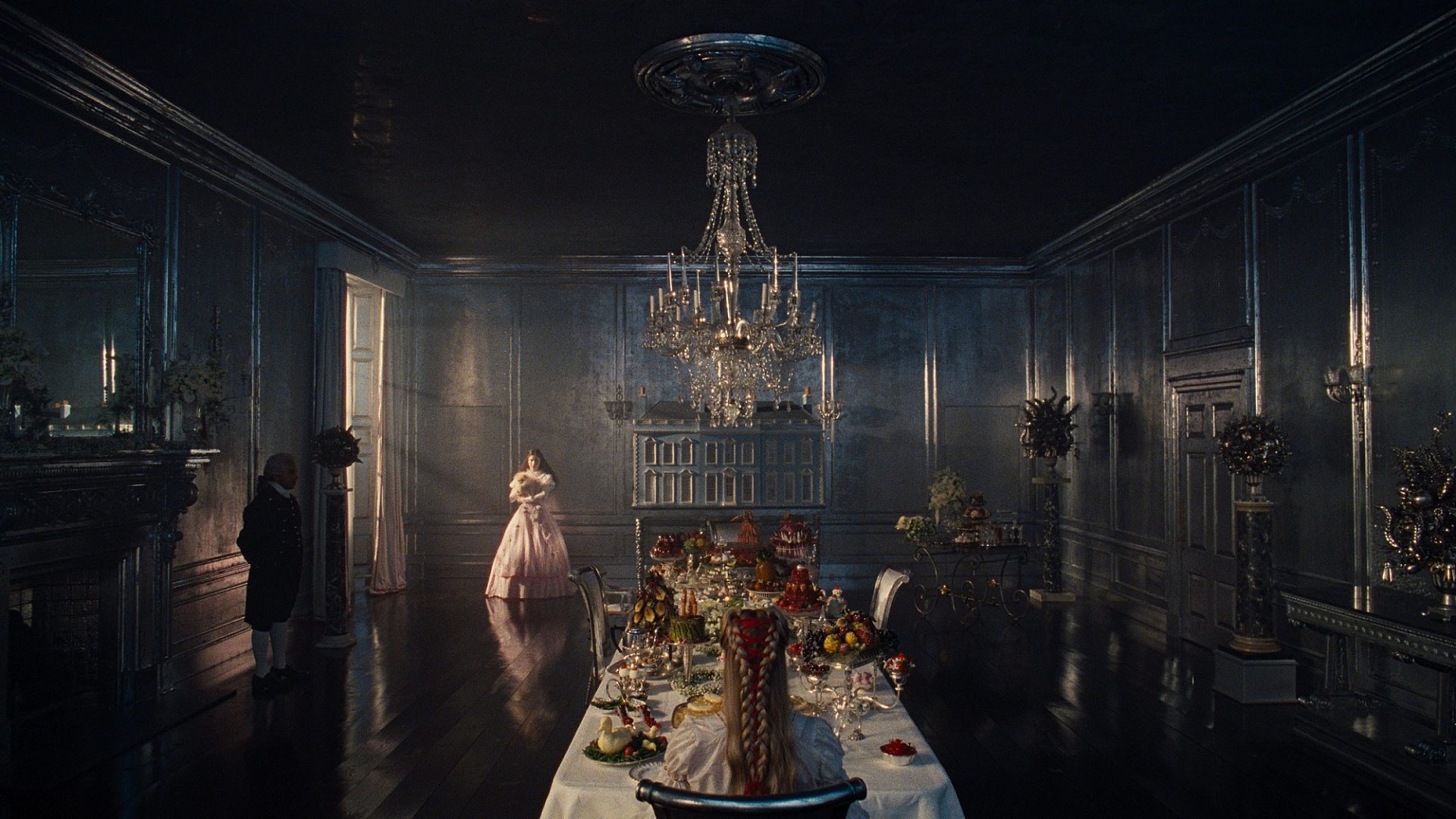
(L-R) Alison Oliver as Isabella Linton and Actor-producer Margot Robbie as Catherine Earnshaw in WUTHERING HEIGHTS, a Warner Bros. Pictures release. Photo courtesy of Warner Bros. Pictures. © 2026 Warner Bros. Ent. All Rights Reserved.
"For example, we pre-lit every direction that the camera would look at around the Wuthering Heights set, using a mixture of LED and traditional fixtures – typically Creamsource Vortexes and Cineo Quantum Studios, mixed with 5K/10K HMIs and 12K Maxi Brute open-faced Tungsten Pars for the keylights, plus a lot of lights above the gray silks.
"I could dim or switch off any of the lights from the lighting board, and was able to shape and sculpt the illumination, using cool or warm light as appropriate to each scene. For the day exterior/interior scenes of Thrushcross Grange, we had two 100K SoftSuns on a track, on either side of the stage, which gave us the ability to easily adjust an exact sun angle, covering the entire set, from a single source. We gelled them usually with full CTS to match the Tungsten bulbs in color.
"We also lit using real fire or candle light as much as possible. I prefer real burning flames, as LEDs lack the full range of color in real firelight, especially red. When we needed a more intense effect, we used an array of small Tungsten bulbs that could be flickered individually from the dimmer board."
Sandgren says he is conscious about the environmental impact of filmmaking, and just as he had done on Saltburn, used sustainable power to mitigate emissions, powering many of the location set-ups with equipment from Green Voltage.
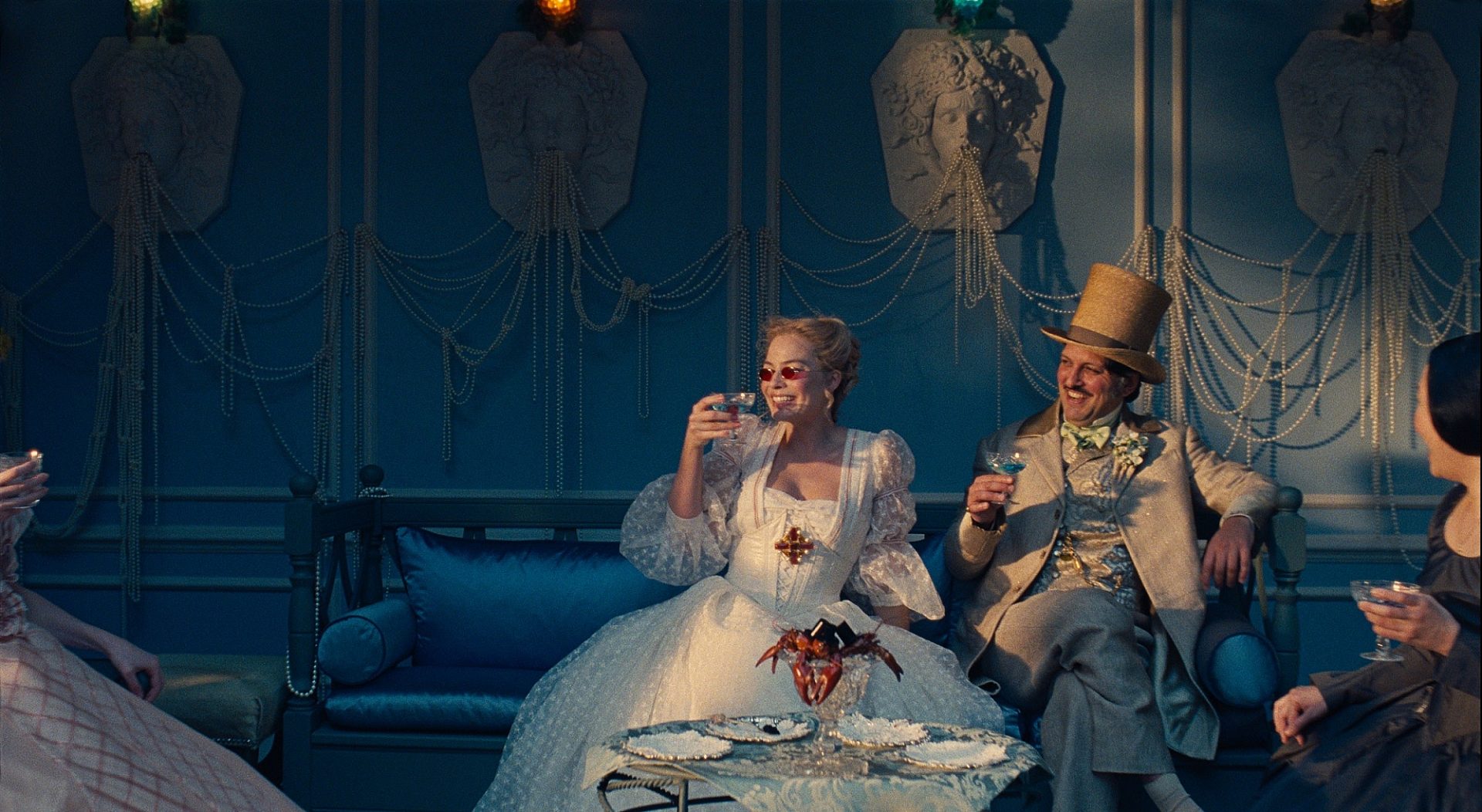
(L-R) Actor-producer Margot Robbie as Catherine Earnshaw and Shazad Latif as Edgar Linton in WUTHERING HEIGHTS, a Warner Bros. Pictures release. Photo courtesy of Warner Bros. Pictures. © 2026 Warner Bros. Ent. All Rights Reserved.
Of his collaboration with production designer Suzie Davies, Sandgren remarks, "The sets she designed – such as the courtyard, stables and farmhouse at Wuthering Heights – were really impressive. Being able to move in and around them with the camera, during rain or shine, brought a real dynamism to the visual storytelling. I was happy that Suzie wanted to build the farmhouse with real-world restrictions – low ceilings, small rooms and no floating walls – as I knew that would give us a sense of being in a real, claustrophobic space.
"It was also interesting to work with her on how the light would reflect off different textures and surfaces, such as the gloss on the walls of Thrushcross Grange, and the cobblestones at Wuthering Heights splashed with pig's blood and urine. And I'm thankful for Suzie's adaptability in adjusting things like the position of the windows to help me plan the light sources, and delivering shiny metal mirrors to throw atmospheric light back from the fireplaces."
Sandgren concludes, "Making Wuthering Heights was another great collaborative experience with Emerald. On this film, there were no restraints in the emotional expressiveness of the visual language. It was very freeing and creative for me in terms of the framing, compositions and lighting.
"A story like this could only be shot on film. Film brings a special magic to the images – from the innate grain and texture, the details in the highlights and shadows, and the way it renders the shades of color so beautifully. And, once again, it delivered a truly engaging and cinematic experience for the audience."
