How the invisible VFX of 'Sinners' protected the large format vision of cinematographer Autumn Durald Arkapaw, ASC

(L-R) Michael B. Jordan plays twin brothers Stack and Smoke in Ryan Coogler's SINNERS. Photo courtesy of Warner Bros.
Sinners, Ryan Coogler's bluesy vampire spectacle, debunks the conventional wisdom that filming in IMAX and VFX can't play well together. The Best Visual Effects Oscar® nominee even made celluloid converts of production visual effects supervisor Michael Ralla and visual effects producer James Alexander. Both are Marvel veterans and long-time champions of digital polish and perfection — until cinematographer Autumn Durald Arkapaw, ASC, shot large format on steroids with 65mm in IMAX and Ultra Panavision 70, turning them into film junkies.
"Going into this project, I wasn’t entirely sold on the decision to shoot on film. From a purely technical point of view, modern digital sensors are almost unrivaled in sensitivity, noise performance, dynamic range, and spatial resolution — and at the time, that was how I evaluated capture formats, especially given my background as a German engineer," says Ralla, who previously worked with Durald Arkapaw on Black Panther: Wakanda Forever and was recruited by director Ryan Coogler and the cinematographer to help protect her organic, naturalistic vision for Sinners.
"Film, on paper, may struggle a little bit to keep up in terms of tech specs," he continues. "The same goes for handling and practicality. But the more I looked into it, the more I realized this project wasn’t about specifications at all. What matters is whether it’s the right medium to tell a story-and [analog] film has done that extraordinarily well for more than 100 years. Over the course of working on Sinners, we learned that much of film’s beauty comes from its imperfections. What makes it so compelling — and so difficult to emulate — is the sum of everything it isn’t good at. That’s what makes it feel human. We’re imperfect beings, and we respond differently, often unconsciously, to things that aren’t perfect. And beyond that, film is simply timeless — it looks stunning on its own and has fundamentally shaped the way we experience movies."
But what really impressed Ralla was Coogler’s insistence that shooting Sinners on film was non-negotiable — the first time since his debut, Fruitvale Station. "He said that whatever you shoot on film is perceived as more real and more authentic, and what we learned over the course of this production is that there’s something about film you can’t quantify. Everybody is striving for perfection, whether it’s digital cameras or generative AI models. James and I work in visual effects, which are 100 percent digital and, as a result, computer-perfect in a certain way. And that’s not necessarily a human quality.

(L-R) The Twinning split screen technique with Michael B. Jordan as twin brothers Stack and Smoke in Ryan Coogler's SINNERS. Photo courtesy of Warner Bros.
"Even though it’s almost impossible to tell the story of Sinners without visual effects, given the twin aspect," Ralla adds. "It isn’t a visual-effects-driven film in the traditional sense: our work was more about subtlety than spectacle and had to blend seamlessly with the photography. To achieve that, we developed a system that recreates the characteristics of celluloid, along with the aberrations of the lenses, with the goal of creating work that’s just as timeless as the film it was captured on — and that it ultimately gets printed on again."
For Alexander (WandaVision, The Marvels), who was brought on by Ralla, Sinners served as a reminder of the power of large format film. "The scale of the image — all the irregularities, the grain, the weave, the aberrations, and artifacts — is a huge consideration from a visual effects perspective," he says. "Knowing that a very clean digital element has to integrate seamlessly into the celluloid and the final projection is incredibly exciting. For me, film is the visual language of cinema — what it means to be in a theater."
Yet Sinners is no ordinary film. It blends Coogler’s trademark emotional storytelling with the rich supernatural traditions of the Mississippi Delta, the birthplace of the blues. The film therefore required complex supporting VFX using both old-school and state-of-the-art techniques, along with a specialized workflow to match the look of Autumn Durald Arkapaw’s cinematography (including Hannah Beachler’s production design and Ruth Carter’s costume design, with whom the VFX team collaborated closely, along with other department heads). In fact, the film features more than 1,000 VFX shots — the most in IMAX history. And all of that within just one year from the start of pre-production to final delivery, and on a limited budget. These VFX contributors included Storm Studios from Norway, Rising Sun Pictures in Adelaide, Industrial Light & Magic Vancouver, Base FX, Light VFX, Outpost VFX, TFX, and Baraboom Los Angeles.
"What we learned is that there’s another aspect beyond technical seamlessness required to match all the qualities of film and the lenses," Ralla explains. "This is something we’ve been working on very closely with Autumn since Wakanda Forever, where we essentially began a science experiment to understand what lenses are doing, what those effects are called, how to break them down, analyze them, and quantify each one. And then, last but not least, to develop a toolkit that can replicate all of that, apply it to the digital footage, and inform people so they understand how to use it and what they’re actually looking at. We actually had to train people on how to composite film seamlessly with digital elements, because a lot of compositors had never worked with film scans during their career.
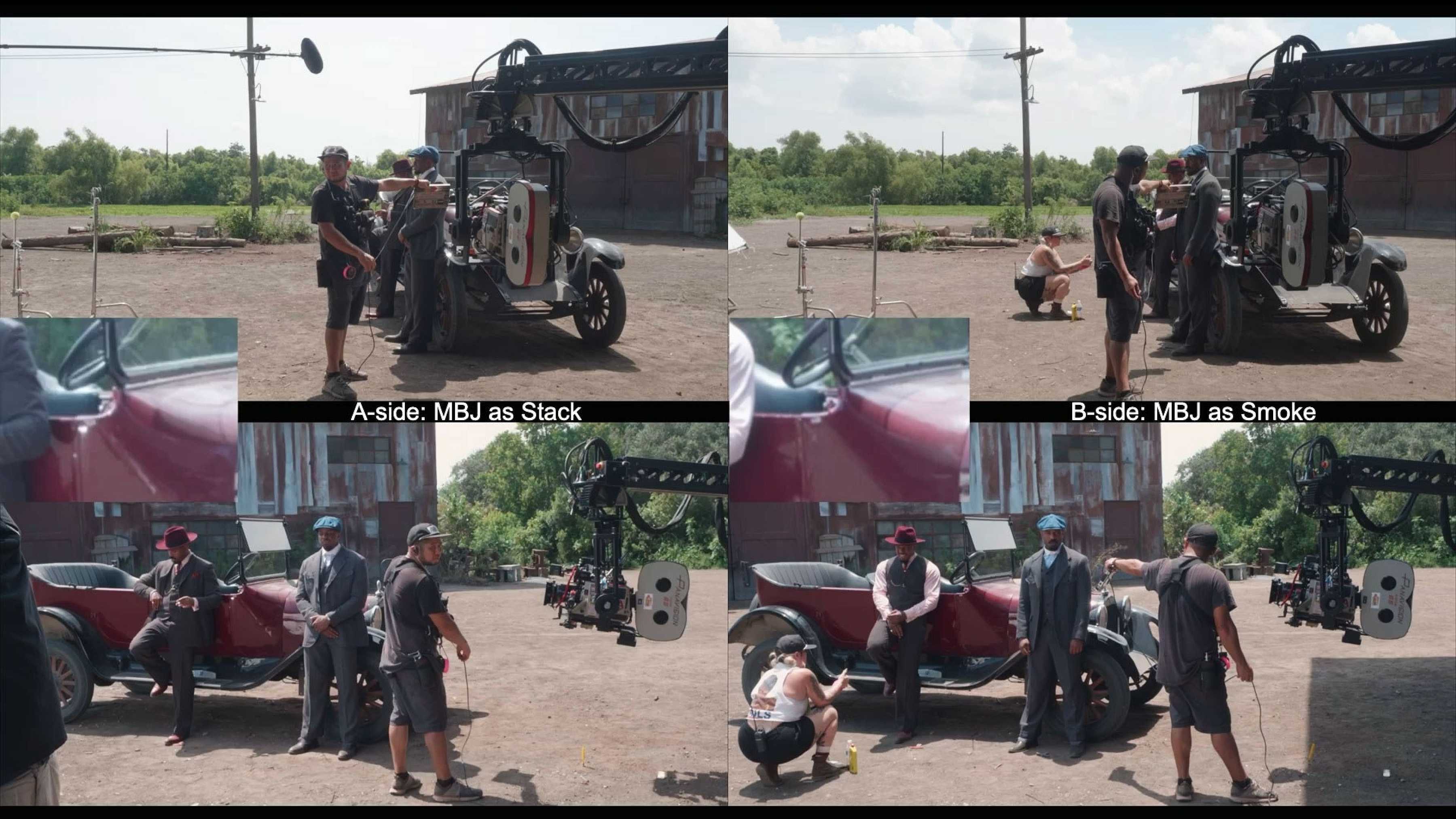
(L-R) A-side and B-side Technodolly split screen technique for Michael B. Jordan as Stack and Smoke on the set of Ryan Coogler's SINNERS. Photo courtesy of Warner Bros.
"During my first conversations about lenses with Autumn on Wakanda Forever, I didn’t understand what I was looking at," Ralla admits. "I didn’t understand the characteristics, flaws, and aberrations that she liked. On Sinners, we also needed to emulate the qualities of KODAK 5219 film stock loaded into all the cameras we were using, whether they were IMAX MSMs or the Ultra Panavision system with anamorphic lenses. But, again, there’s also a creative seamlessness that has to happen in front of the camera, which I call preservation of creative intent. Ryan chooses all his collaborators carefully and encourages everyone to bring their A-game. If there are now shots that we complete to a large degree in postproduction, there can be a bit of a danger that the original intent of those people gets lost. We can study all the references, but on this film, we looped Autumn and Hannah into postproduction and basically encouraged them to use us as a digital construction department to build set extensions — which, in turn, matches everything built on set, as it was designed by the same hand and mind. As a result, you get something that’s both technically and creatively seamless."
Among the highlights are the twinning effect of Michael B. Jordan as identical brothers Smoke and Stack —achieved with a Halo rig and a Technodolly split-screen technique — a surreal musical montage of blues ancestors and descendants appearing in the juke joint as embers drift skyward, and vampires burning up in a lake as the sun rises during the action-packed climax.
"The twinning was the first major challenge we tackled from a visual effects standpoint," Ralla says. "We needed to see Michael multiple times on screen as Smoke and Stack, so we looked back at great references (The Social Network, The Parent Trap, Dead Ringers) and every tool available to us. The Technodolly came into play whenever we could use a split-screen approach to show both twins in frame at the same time. It’s a highly mobile, adaptable system that lets you replicate camera moves and stitch the plates together with identical motion.

(L-R) Director Ryan Coogler and Michael B. Jordan wearing the Halo Rig for the Twinning effect on the set of SINNERS. Photo courtesy of Warner Bros.
"The best shot was the introduction of the twins, starting on Stack leaning against a car, with the camera moving around to reveal Smoke behind him," Ralla recalls. "It was a particularly complex setup. We originally thought Stack would roll a cigarette, pass it to Smoke, and move on. But Ryan didn’t want to leave the moment too quickly, so we ended up passing that cigarette back and forth seven times using a spatial marker."
Meanwhile, the team used the Halo Rig, purpose-built for the film by Wild Rabbit Aerial, based on input from Rising Sun Pictures, for choreographed fight scenes between the twins, with the visual effects studio enhancing its workflow to meet IMAX quality standards. The rig is a specialized circular shoulder harness fitted with multiple cameras, which Jordan wore twice for intricate performance capture.
"We took their spec sheet and adapted it to fit what was doable within the parameters of the movie," Ralla explains. "That meant it had to happen on set, in the right lighting, and in the moment, when everything was fresh. Michael needed a little time to shift his mindset from Stack to Smoke, which we had to learn. But he got faster and faster with makeup and wardrobe changes every day."
For the surreal musical montage, shot in IMAX as a single three-and-a-half-minute take, a lot of the heavy lifting happened during prep, with a camera path designed by the cinematographer, detailed previs from Baraboom, and extensive blocking rehearsals. "It was an intense but incredibly rewarding collaboration," says Alexander. "But we only had 75 seconds in the magazines, which had to be spooled down to 50 percent because the IMAX MSM camera was mounted on a Steadicam and was too heavy. That meant we had to introduce stitch points and move from one segment to the next in order to achieve a continuous and fluid 'oner.'

The fiery effect for the Surreal Montage sequence from Ryan Coogler's SINNERS. Photo courtesy of Warner Bros.
"Then we get to the tilt up to the roof," Alexander continues. "It was the last day of principal photography, and we staged a real roof burn at the actual location in Louisiana, smoking out the entire set. It was surreal. Autumn thought we were insane, putting multi-million-dollar cameras underneath, but it all worked beautifully and was grand finish of production.
"At one point during post, Ryan came to our office and asked, ‘What would it take to push through the burning roof?’" Alexander adds. "And, at that point, the IMAX roof-burn element became high-end reference for a fully digital recreation."
But the film’s final battle with the vampires in the bayou features the most ostentatious use of supporting VFX. This was achieved in close collaboration with SFX makeup and stunts, under the umbrella of Coogler’s direction and Durald Arkapaw’s cinematography. "We developed a Gantt chart for that beat," recalls Ralla, "and SFX makeup supervisor Mike Fontaine designed five different stages of death and burning that were applied to Jack O’Connell, who plays the head vampire, Remmick."
Yet the moment of the sun cresting over the horizon at this pivotal point, created with four CG shots, was equally crucial. "The whole film plays out over the course of 24 hours, and the movement of the sun as a ticking clock is a big part of the story," Alexander explains. "We were filming in the very early hours of the morning in the bayou and were pretty exhausted. That moment when the sun comes up is a very small window. We got some fantastic shots, but we didn’t capture the actual sunrise itself."

VFX supported the SFX makeup burning of vampire Remmick (Jack O'Connell) in Ryan Coogler's SINNERS. Photo courtesy of Warner Bros.
That moment was ultimately created using panoramas of the entire environment that had been captured earlier as VFX reference. "Which meant we were able to create the moment using real-world information," Alexander continues. "Our partners at Storm VFX in Oslo built very sophisticated water simulation programs, allowing us to realistically recreate the bayou water and accurately place the sun, creating those shots entirely."
But, as with everything else, the goal was to preserve creative intent. "We take all the creative intentions from the people who were there during production and make sure they’re protected and represented during post," Ralla emphasizes.