How director Paul Thomas Anderson and DP Michael Bauman Re-Imagined 35mm VistaVision for the action-packed 'One Battle After Another'

Leonardo DiCaprio stars as ex-revolutionary Bob, on the run, in Paul Thomas Anderson's ONE BATTLE AFTER ANOTHER. Photo courtesy of Warner Bros.
While The Brutalist revived VistaVision last year (earning Lol Crawley the Best Cinematography Oscar), director Paul Thomas Anderson and director of photography Michael Bauman took the 8-perf/35mm horizontal format to new cinematic heights with his absurdist political actioner, One Battle After Another.
In fact, Anderson has been courting VistaVision for more than a decade. He started by testing one of the immensely large vintage cameras on The Master (2011) but eventually switched to 65mm when it proved impractical.
Yet the director was able to make VistaVision work for One Battle, starring Leonardo DiCaprio as ex-revolutionary-turned pothead-recluse Bob, who resurfaces after 16 years in a desperate search for his missing teenage daughter, Willa (Chase Infiniti), who's been abducted by military zealot Lockjaw (Sean Penn).
The format (created by Paramount in the '50s and the forerunner of IMAX) was perfectly suited to the scope and energy of One Battle (which was inspired by Thomas Pynchon's novel Vineland). The epic landscapes and thrilling car chases definitely benefited from the larger negative area, higher resolution, sharper depth of field, and reduced grain. These became indelible and immersive images in the 1.50:1 frame.
The film stocks were KODAK VISION3 500T 5219, VISION3 250D 5207, and VISION3 200T 5213.

Director Paul Thomas Anderson, Leonardo DiCaprio, and Benicio del Toro on the set of ONE BATTLE AFTER ANOTHER. Photo courtesy of Warner Bros.
"I think this movie is such a big canvas [for VistaVision]," says Bauman, who began as a gaffer for Anderson (The Master, Inherent Vice), then graduated to lighting cameraman (Phantom Thread), before serving as co-director of photography with him on Licorice Pizza. "We've had this aesthetic conversation since Phantom Thread that it has to have texture to it, it's got to look like a movie, and so he was pretty adamant about it."
They first got their hands on a vintage Beaumont VistaVision camera owned by actor-turned cinematographer Giovanni Ribisi (Strange Darling). This became the A camera, lovingly restored, with two additional bodies supplied by Geo Film Group.
"He's a collector of all sorts of stuff and he had this one that was in great condition," Bauman adds. "And I remember we brought it to a test at Panavision, and Paul was like, 'I don't know, this would be like taking your beautifully restored 1957 Chevy out and running it around through the mud.' And Giovanni was like, 'This is not a precious artifact, this is for making movies. So please take it and go make a great movie.'"
They made major tech upgrades at Panavision to the VistaVision camera. Among the challenges were range, logistics, and film run-time duration. This was overseen by Dan Sasaki (senior vice president of Optical Engineering and Lens Strategy) and Guy McVicker (director, Technical Marketing). The engineering team assisted with the design and fabrication of parts to make the cameras easier to service and maintain. Handheld, studio, stabilized-head, and aerial-photography components were all purpose-built, along with general AKS accessories. They also built a prototype viewfinder for the A body to allow a brighter and sharper image for the operator.
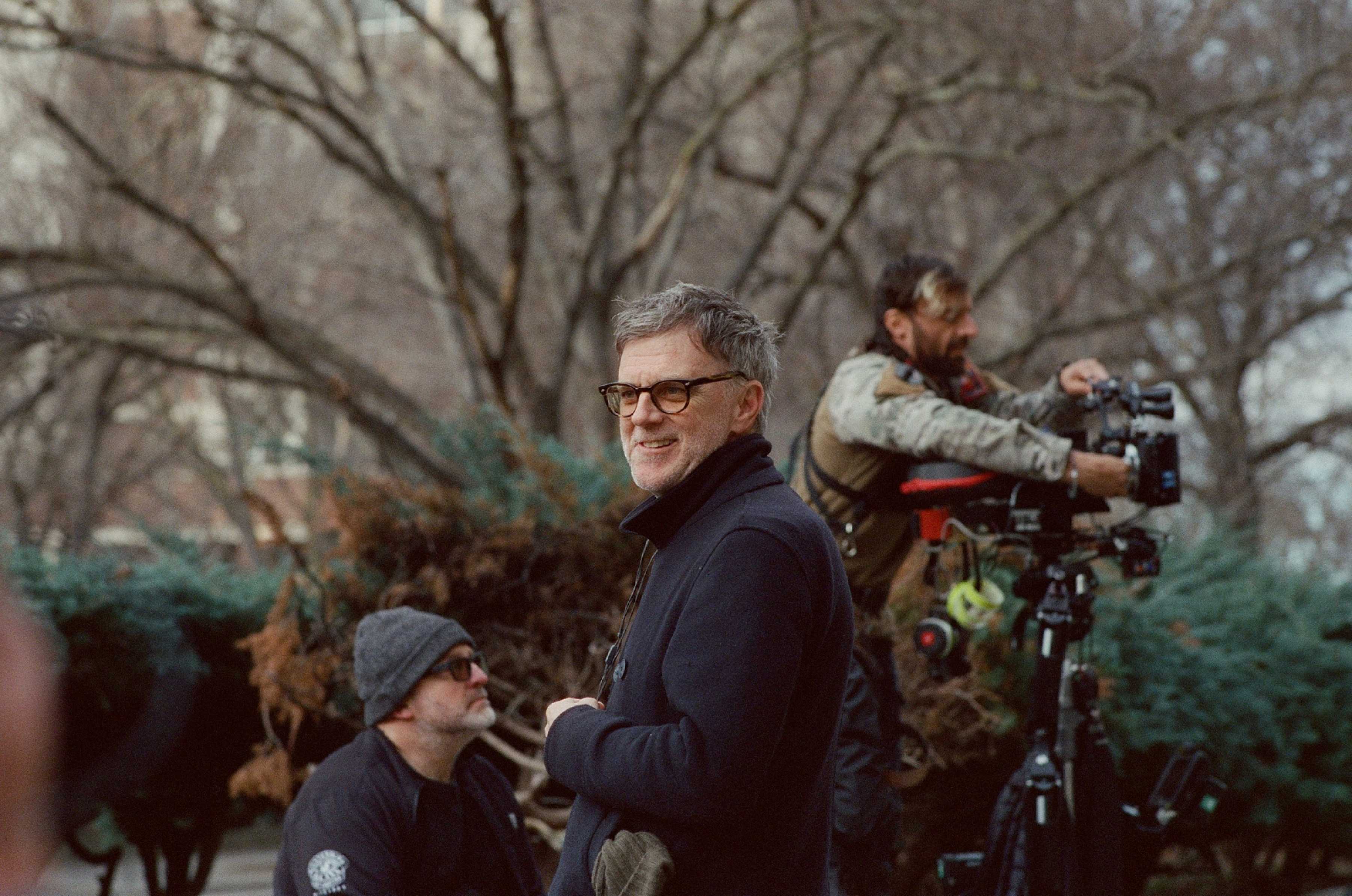
(L to R) Cinematographer Michael Bauman, director Paul Thomas Anderson, and first assistant camera Sergius Nafa on the set of ONE BATTLE AFTER ANOTHER. Photo courtesy of Yana Yatsuk and Warner Bros.
But because the VistaVision camera is very noisy, they opted to occasionally shoot in Super 35 with the Panavision Millennium XL2 camera, particularly for more crucial interior dialogue scenes.
Meanwhile, they relied on Sasaki to provide a special package of more than 60 spherical lenses. Many of the lenses that were ultimately used had to be modified to clear the VistaVision camera mirror and ground-glass assembly. Anderson had previously used Panavision's Super Speed lenses in the past because he was very fond of the films that legendary cinematographer Gordon Willis shot with those lenses. He wanted that look with VistaVision, so Panavision built a new set of prototype prime lenses with the same optical characteristics but made to cover the VistaVision film frame. The lenses have a nice flare quality, and skin tones render in a very pleasing way.
All of this work enabled Anderson's camera crew, known as "The Five-Headed Monster," to make his most action-packed film to show off in the VistaVision format. In addition to Bauman, they included Camera Operator Colin Anderson, 1st AC Sergius Nafa, Key Grip Tana Dubbe, and Gaffer Justin Dickson.

Benicio del Toro plays the Zen-like Sensei Sergio in Paul Thomas Anderson's ONE BATTLE AFTER ANOTHER. Photo courtesy of Warner Bros.
The lenses have a nice flare quality, and skin tones render in a very pleasing way. For instance, if you’re framing an actor in close-up, the background falls off nicely while more of their face stays in focus.
"But one thing that is really critical is a lot of these lenses were incredibly warm," Bauman says. "And those tended to be what Paul responded to the strongest. In fact, some of the times they would time out the chaos to make it all the same, and he was like, 'No, no, leave the messed up.' Any of those color aberrations were welcomed."
They filmed mostly on location in Northern and Southern California and El Paso, Texas, where they had to be super mobile with a light footprint, trying to find the light. They mixed color temperatures and often used neon and fluorescent tubes for interiors.
The movie begins with the storming of an ICE detention center to free 300 immigrants. Explosives expert Bob joins the revolutionary group called the French 75 and immediately falls for badass Perfidia (Teyana Taylor). But their thrilling life of crime robbing banks gets complicated with the birth of Willa and the capture of Perfidia.
The opening was shot on a pop-up set near the border wall south of San Diego near Tijuana. The view from the freeway underpass even revealed actual immigrants crossing the border with background actors. It was lit with strategically placed practicals. "We [used] a lot of Wacker light towers used for construction sites, but they don't have intensity controls, so they ended up making various levels of neutral density, so we could at least adjust the intensity of the light," Bauman adds. "It was a really interesting energy and aesthetic of industrial ugliness: the silver blankets that were all over the ground, and the coolness of the LED mixed with these other color temperatures, the sodium, just adding fixtures.
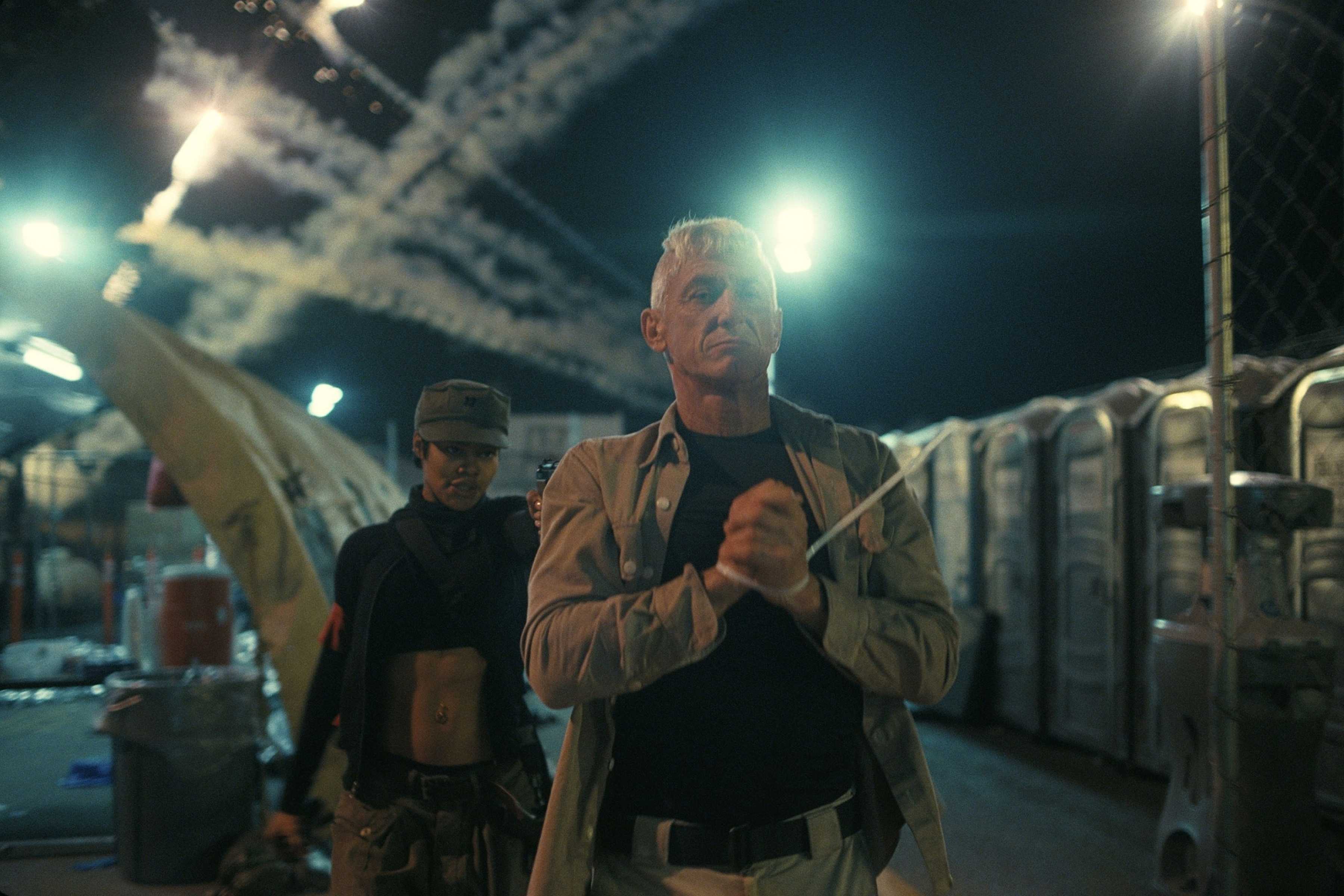
Teyana Taylor (Perfidia) and Sean Penn (Lockjaw) on the set of ONE BATTLE AFTER ANOTHER. Photo courtesy of Warner Bros.
There's one noteworthy shot in an area called the "Dog Pound," where soldiers walked through the cages. "You'd see the kids inside, walking down a long line, and I had to do a stop pull from a T1.4 to a T22 in one shot," continues Bauman. "I'd never done that kind of a pull before. And they were constantly adjusting intensities as things were happening because you had to just go with the improv of what was going on. And we'd work a shot out."
Benicio del Toro, who plays the Zen-like Sensei Sergio, joined mid-way in production when they were shooting in El Paso. The improv between DiCaprio and del Toro was established immediately, and they learned to light around them in a way that accommodated their freewheeling performances. "Paul was kind of finding the voice for that section of the film," Bauman adds. "And so when they would just start riffing on something, it would be like, 'OK, we're going with this. And that kind of looseness defined much of it as far as being able to light and grab those moments."
For example, when shooting a scene in Sergio's apartment (where they built out the undeveloped second floor to provide a lot more space), a happy accident occurred when Bob makes a phone call and the curtains accidentally fall down, allowing them to expose the street below. "It was like, 'OK, the light is this way now,' Bauman says. "And Justin, our gaffer, projected something on the wall, and it was about having messiness and embracing light that wasn't sculpted. We had a lot of small sources that we could hide quickly because you had to respect the improv."

Leonardo DiCaprio stars as explosives expert Bob, who joins the French 75 revolutionary group, in Paul Thomas Anderson's ONE BATTLE AFTER ANOTHER. Photo courtesy of Warner Bros.
The highlight of the VistaVision were the car chases, especially the tour de force with Willa taking charge shot in Borrego Springs, San Diego, known as the Texas Dip. The magic hour in the rolling hills of the Borrego required quick reloads and tactical positioning of support to accommodate a run that was miles long.
In addition, the rolling hills were great for the wide angle, but it was hard finding a stabilized head for the VistaVision camera, which was attached to an arm car. They had the additional use of an elevator car camera rig that went up and down right behind the car. This really tested the reliability of the camera. "You're banging that thing around and there would be times it jammed and you'd do it again," Bauman says. "It was all about the energy. But the sun was just so punishing out there."
In the end, the experience for Bauman and the rest of the film crew was hard but fun, with a huge level of kinetic energy, always pushing through the extreme conditions with the VistaVision camera. But to best showcase its visual power, One Battle will be presented as a special theatrical event in different formats. First, it will be projected in VistaVision (in the native aspect ratio of 1.50:1) for the first time since the '50s. This will be courtesy of vintage horizontal projectors, which have been upgraded for the limited engagements in Los Angeles (Vista Theater), New York (Regal Union Square 17), Boston (Coolidge Corner Theater), and London (the Odeon Leicester Square).
One Battle also marks the first IMAX 70mm release for Anderson (in an atypical 1.43:1 aspect ratio at select IMAX locations). "We'd shoot 'til absolutely last light, to try and get anything in the sky we could just to get some sort of silhouette, some sort of detail, even if it's just pushing it two stops, two-and-a-half," Bauman adds. "But I think this is going to be an event film in so many different formats: Vista, IMAX 70, IMAX DCP, 70mm."