Shooting on KODAK 35mm, DP Darius Khondji, ASC AFC rediscovers the joy of capturing faces in Josh Safdie's table tennis drama 'Marty Supreme'
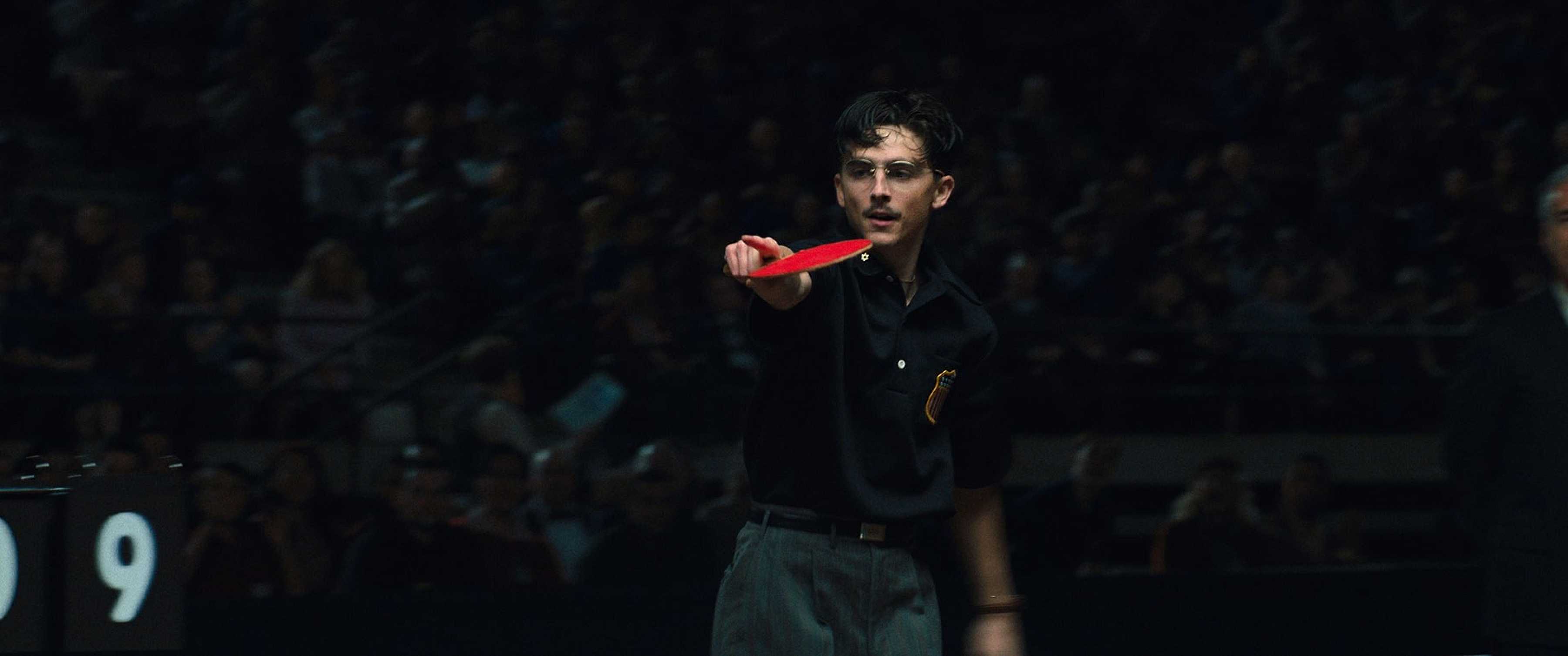
Timothée Chalamet makes a point as the titular protagonist during a London table tennis match in MARTY SUPREME. Photo courtesy of A24.
For cinematographer Darius Khondji, ASC, AFC, shooting Josh Safdie's Marty Supreme revived his passion for 35mm film. That's because the 1952 sports drama allowed him to focus on an assortment of fascinating faces — especially Timothée Chalamet's, who plays the titular protagonist: a fast-talking, obsessive table tennis hustler.
"Marty brought me back to shooting film more than any other film before," Khondji says. "It's the first time that I really realized that I'm closer to what I want to do, shooting with film stock and our 360mm lenses." In this case, it was the KODAK VISION3 500T Color Negative Film 5219, with the Arricam-LT and primarily the Panavision C Series lenses.
"It's something that gives me more pleasure," Khondji continues. "I don't know if it's because of the period part of it or because we're shooting so close to the faces all the time. The film stock gives you a canvas, it's almost like a painting, like the crust of a painting, like the skin of a painting. On digital, you don't really get that. You reproduce random pixels and things like that."

(L-R) Tyler Okonma as Wally and Timothée Chalamet as the titular protagonist during a table tennis hustle in MARTY SUPREME. Photo courtesy of A24.
And what a canvas Safdie provided in this story about the New York misfits, weirdos, and grifters drawn to table tennis in the '50s. Table tennis has been a part of Safdie's family for generations. But when he read the autobiography of the flamboyant table tennis hustler Marty Reisman, The Money Player: The Confessions of America's Greatest Table Tennis Champion and Hustler, Safdie knew that he had the perfect vehicle for Chalamet, who even resembles Reisman. Like Uncut Gems (which Khondji also shot), Safdie was once again drawn to a dark and twisted metaphor about the American Dream. For the titular protagonist, the journey was like going to hell and back.
Indeed, Safdie told Khondji that he envisioned the "brash beauty" of Uncut Gems translated to 1952. "I photograph faces all the time, but this changed my way of thinking about film and digital," adds Khondji. "Now it's obvious, I can see the difference. When I push the negative slightly, it gives a special texture to the image that I cannot get from digital." He credits camera operators Colin Anderson and Brian Osmond, gaffer Ian Kincaid, and colorist Yvan Lucas.
Khondji credits casting director Jennifer Venditti for her brilliant ensemble of timeless-looking actors, which also includes Gwyneth Paltrow, Odessa A'zion, Fran Drescher, Kevin O'Leary, Tyler Okonma, Sandra Bernhard, Abel Ferrara, and table tennis star Koto Kawaguchi as rival Koto Endo.
"It has a lot to do with the street casting and the casting of Josh and Jennifer," Khondji suggests. "It was like this on Uncut Gems, but it became so much more powerful on Marty. This way of working with 140 or 150 people, most that you don't know."

(L-R) Cinematographer Darius Khondji and director Josh Safdie on the New York shoe store set of MARTY SUPREME. Photo courtesy of A24.
For reference, Khondji revisited such photographers from the '50s as Ernst Haas and Helen Levitt, as well as American experimental filmmaker Ken Jacobs. But it was French painters Honoré Daumier and Georges Bellows, who provided the most valuable inspiration for the table tennis. It was not only the iconic faces but also the warm way they were lit from the bottom, which he applied sometimes to the movie. "It comes from Marty first, of course," Khondji emphasizes. "From the way he acts and his face. The 'brash beauty.' I love that expression."
Additionally, the cinematographer lauded the evocative period world building of legendary production designer Jack Fisk (The Tree of Life). "With the texture, the layers, the things that he put in the film, he gave us a lot of the realness of the time," recalls Khondji. A great example is the opening in the shoe store and our introduction to Marty's supreme salesmanship.
"This has a very painterly look," he continues, "like on the skin tone and all the boxes, in the hallway, the way it captures the light. The pushed film really worked very well there. It was the beginning of the movie we started shooting these scenes, on location near the Lower East Side. And Jack reproduced it accurately. It was very small, with little room, we shot with two cameras from different angles, and outside was blue. I was so excited to see the reproduction of that color on film in the shoe store, looking out, because of the color separations."

Timothée Chalamet as the titular protagonist on the run through New York's Lower East Side in MARTY SUPREME. Photo courtesy of A24.
One of the most difficult sequences to shoot was Marty's mad dash through Orchard Street in the Lower East Side to elude the police. "It was very hard to find an angle that looked like the '50s," Khondji recounts "It was a huge challenge for Jack, but he never made us feel that. We found some chunks that worked really well. It was a crazy mount: a camera truck, a camera car with small crane, hand-operated by our great grips Joe [Belschner] and Richie [Guinness Jr.] and then operated by the camera operator, Colin [Anderson]. But it was the best way because of the angle of the street."
The French Connection was one of their guardian angels and Khondji gave additional shout outs to his other camera operator, Brian Osmond, gaffer Ian Kincaid, and colorist Yvan Lucas. "When we worked with Josh, it was always very, very tight," he adds. "But here we had a little bit wider with a 35mm or 50mm or 40mm in anamorphic, and we ended up doing takes with also longer lenses. We even used a CinemaScope film camera that was in a museum. It was incredible but very difficult to use."
For the gripping table tennis matches in London (shot in New York's Lower East Side), Khondji used three cameras and very long lenses sometimes mixed with wider angle lenses to capture the dizzying back-and-forth of what was playing out in front of them. In almost documentary fashion at times, the cameras were shooting at each other, one hidden between two actors. "Josh and I wanted to shoot the ping-pong in a very classical way," he explains. "And not like a commercial, making it crazy dynamic. We just wanted to tell a story about where this man was, and the ping-pong becomes very exciting to watch.

Timothée Chalamet makes a point as the titular protagonist during a London table tennis match in MARTY SUPREME. Photo courtesy of A24.
"We wanted to photograph it almost like a vision of someone," Khondji continues. You have no idea we're far, far away with the longest zoom of Panavision, and sometimes putting a doubler in front of it. And sometimes moving with it, we're handling the long lenses, sometimes awkwardly like in the '40s or '50s. It was a very interesting process."
By contrast, the mood was very different for the matches in the smoky ping-pong parlors, including the iconic one in Times Square, which Fisk made dark by closing the windows. "We wanted to give those parlors different personalities and you see all these faces," Khondji says.
Meanwhile, the climactic table tennis exhibition between Marty and Koto benefited greatly from being shot outdoors in Tokyo, during the day. "We looked at different places near New York and we couldn't find that place that we wanted," explains Khondji. "We needed so many extras. But we found out that we were able to have a few days in Tokyo. So we decided to bring a minimum number of people and use a Japanese crew.
"This was a very good idea," he continues, "because it created a very different environment. We wanted to do a mix of daylight and fill, but mostly lit by [natural light]. And we shot with three cameras. And it's more intimate because of the lenses we used. I don't think it would've felt the same in New York. It felt completely different when we were there. You can see it on the film, I think."
In the end, Marty Supreme fulfilled its promise for Khondji. It was unexpected, full of discoveries, and an electrifying metaphor about life. "Marty is completely obsessed and ruthless about everything, just for an ideal," he suggests. "In a way, the man is in search of himself, almost denying the essential of life. And then discovering, suddenly, who he is and then landing back on Earth. And this is life.
Marty Supreme, from A24, in theaters December 25.