Director Mark Jenkin shoots Kodak 16mm for his time-traveling, Cornish folktale 'Rose of Nevada'
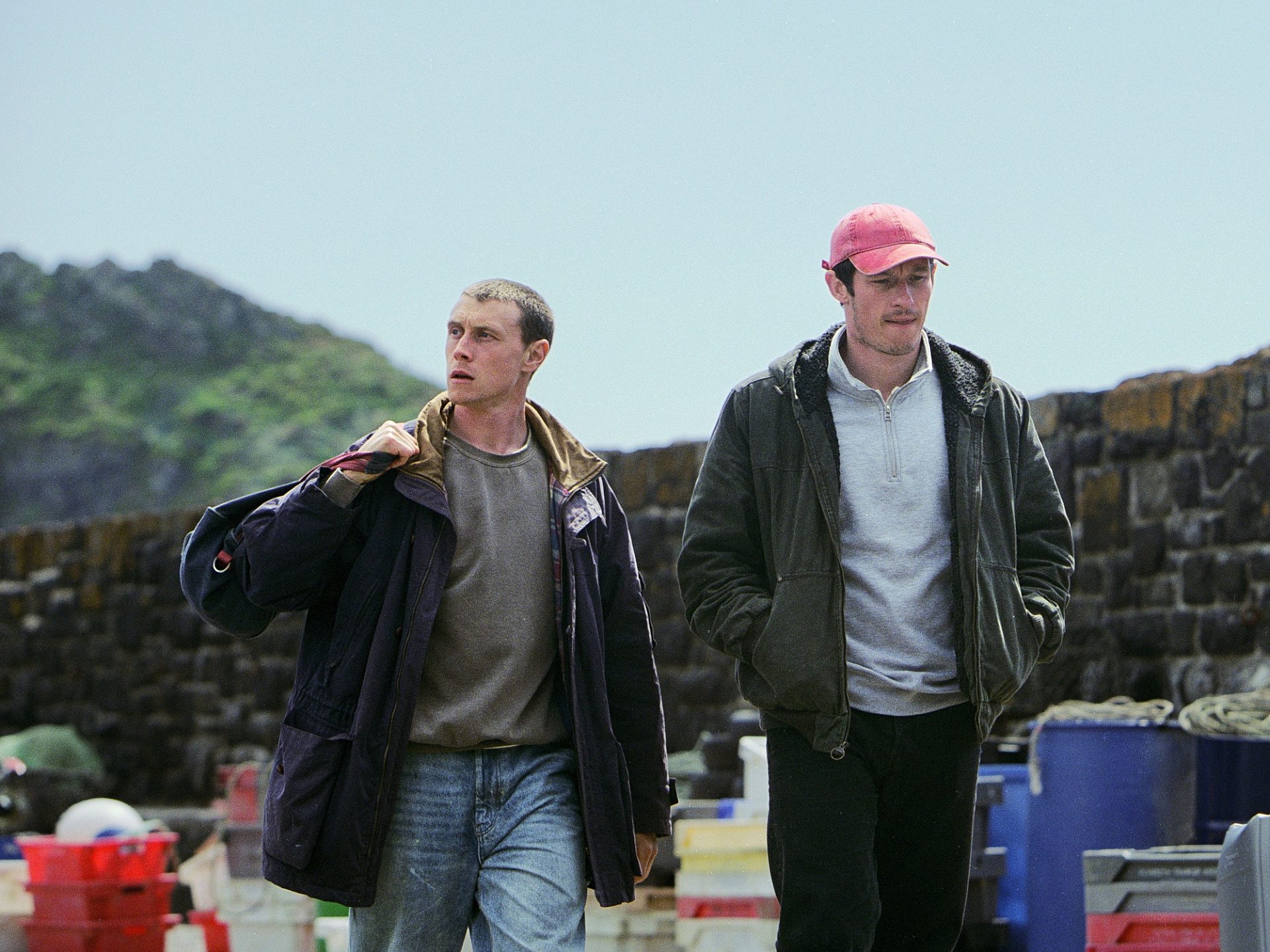
George MacKay and Callum Turner play two fishermen hurled back in time in Mark Jenkin's ROSE OF NEVADA. Photo courtesy of 1-2 Special.
Cornish director-camera operator Mark Jenkin, the master of shooting 16mm on his trusty '76 Bolex H-16 SB camera, is back with Rose of Nevada: a time-traveling, maritime folktale in the trippy tradition of his acclaimed Enys Men and Bait.
Rose of Nevada follows a missing fishing boat that docks in a depressed Cornish village 30 years after vanishing. George MacKay and Callum Turner portray Nick and Liam, who are so desperate for work that they crew up aboard the ghost ship to shore up the economic fortunes of the coastal town
But upon their return, Nick (who has a wife and young child) and Liam (a laconic drifter) discover that they have somehow stepped back in time 30 years to 1993. Even more bizarre, the village believes that they are the original deceased crew members.
"Well, we're all-time travelers in our heads, aren't we?" proclaims Jenkin. "We're all looking backwards. We're all struggling to stay in the moment. It's a multi-billion-pound industry to try and keep us to stay present in the moment because our natural inclination is to travel into the past or project into the future, isn't it? I'm a big believer that's why we had to invent cinema: it was to make sense of the crazy way our minds work."
The premise for Rose of Nevada was conceived by Jenkin out of necessity during the pandemic lockdown when he was in the headspace of wanting to generate ideas. "My partner Mary [Woodvine], the actress, who was the lead in Enys Men and had a part in Rose of Nevada, said to me, 'Have you got any ideas?' I said, 'Well, I got one scene, which is this boat turning up 30 years after it hit the sea with all the crew being lost.' And she said, 'Then what happens?' I said, 'I don't know.' And she said to me, 'What happens if not everybody in the community is surprised that this boat has come back?'
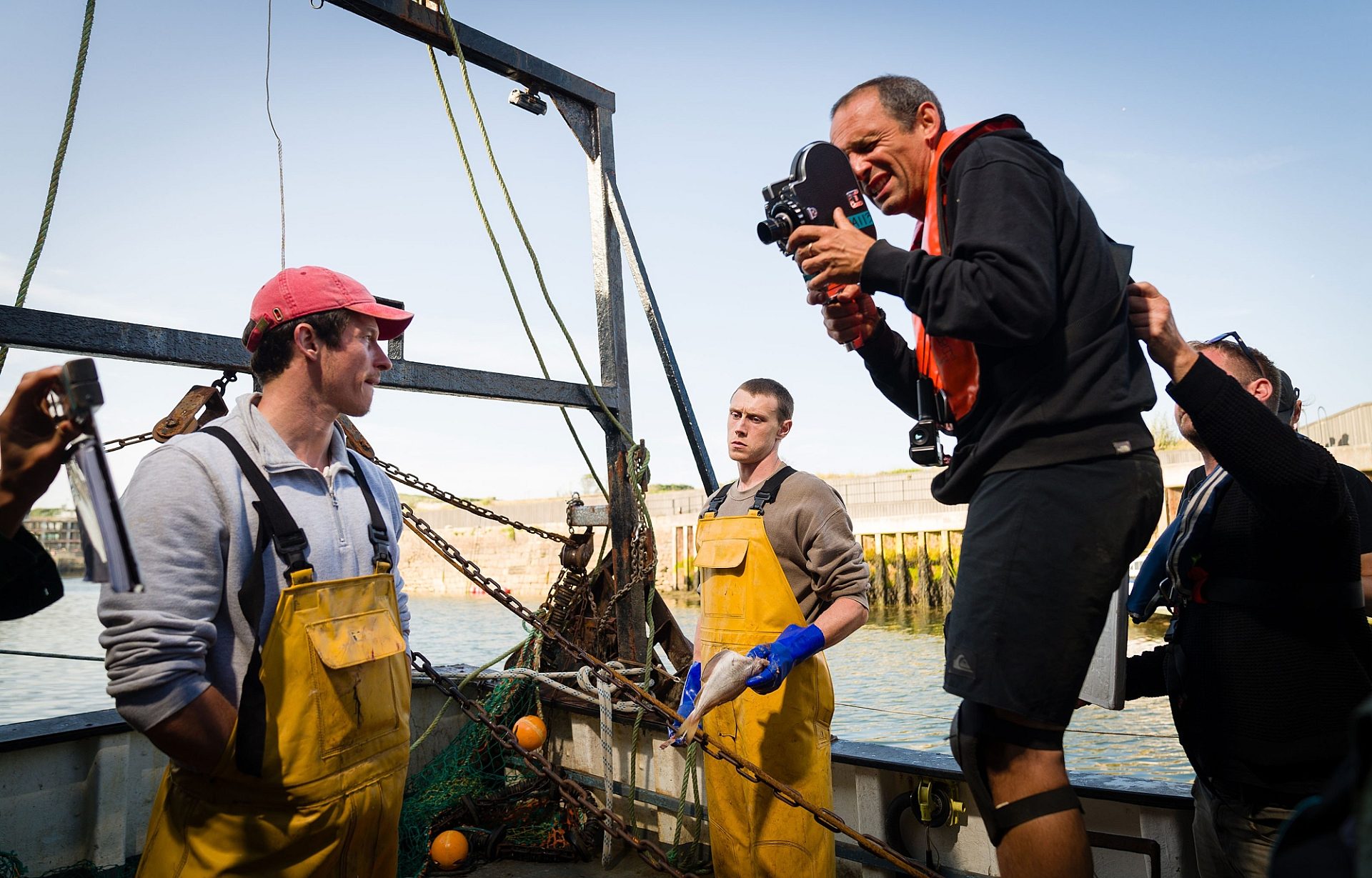
Callum Turner, George MacKay, and director-cameraman Mark Jenkin on the titular boat in ROSE OF NEVADA. Photo courtesy of 1-2 Special.
"And that was the moment that the story opened up for me," Jenkin adds. "Because then it became a mystery, not about where this boat has been, but about the reaction to people when this boat comes back."
This enabled Jenkin to once again shoot entirely in his hometown of Newlyn in Cornwall, England, including the harbor, fish market, and nearby sand dunes. Thus, Rose of Nevada offered the perfect continuation of his analog, aesthetic, allowing him to create rich, highly textured colors and heavy grain, while leaning into the imperfections of film with its blotches and scratches.
Also, as a result of the formal restrictions of the clockwork Bolex (with its 27-second shot limit), Jenkin continued to serve as an astute observer of naturalistic detail, embracing extreme close-ups of physical objects (such as rusted metal, chipped wood, and wet roof tiles), along with the stillness of the performances. His prominent actors, MacKay (1917) and Turner (Masters of the Air), in fact, embraced the austere filmmaking style, which includes post-sync sound recording.
"It is weird because I cast them in some ways because they were so different," Jenkin recalls. "And then, the more I got to know them, the more I realized that, below the surface, they're kind of two halves of the same person. At that point, to me, they started looking like each other."
Jenkin, who prefers the 1.35:1 aspect ratio for its intimacy, shot KODAK VISION3 stocks: 250D 7207, 50D 7203, and 500T 7219. The shoot was mostly outdoors, and the choices were based on weather conditions during the height of summer. "The 250 was for daylight, when we were working in lower light," he says. "I wanted to use the 50 for all the night shoots, so I didn't have to filter it too much. But my favorite stock is the 500T because the more grain, the better for me. But it's tricky with the Bolex because of the dim viewfinder."
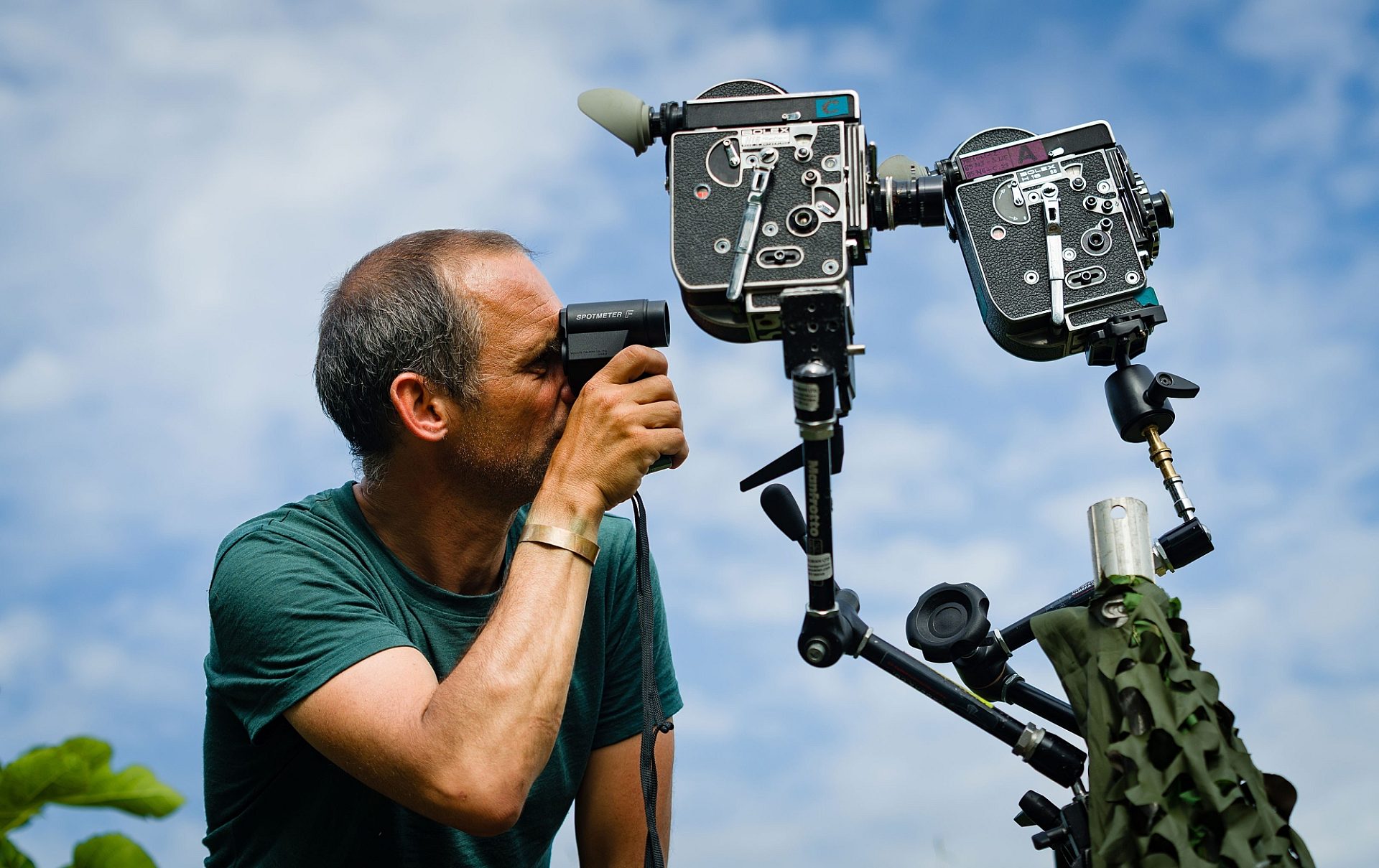
Director-cameraman Mark Jenkin with his trusty Bolex camera in ROSE OF NEVADA. Photo courtesy of 1-2 Special.
The director used Kern Macro-Switar lenses. While he preferred to shoot everything on a 26mm lens with the Bolex, he occasionally used 10mm for hand-held shots to soften movement on the boat and for a few wides at sea. He sometimes resorted to 50mm and 75mm focal lengths for logistical reasons calling for a longer lens.
"I always say to the actors straight away, you're the most important thing in the film," Jenkin explains. "You're the people that are exposing yourselves; you're going to be vulnerable. You've got to put your trust in me during the shoot and then in the edit, where I'm going to rebuild your performance. I'm asking a lot of you, and you are the priority. But with the caveat that everything starts with the camera because that is the eye. It sees everything. And once you're working in close-up, you're fragmenting scenes, and that creates the rhythm."
However, he broke the spring three-quarters of the way through the shoot. Jenkin attached a motor to the side of the camera, which meant they could shoot two and a half minutes on a 100-foot roll. "The hardest thing was not to do that, to keep the integrity of not going past 27 seconds. I thrive on limitation, or it gets sloppy with me."
As on his previous two features, Jenkin sent the negative to Kodak Film Lab at Pinewood for processing before being scanned to 4K. "I don't really like looking at dailies at all," he says, "but I would just quickly skim through it all just to check that my exposures were consistent, my focus was decent, and that there was no anomalies with the neg or that could be traced back to the camera.
"My instruction to the lab is always no digital cleanup and to scan every single frame because, as you can see in the film, I like the light sort of fogging at the beginning and the end of each 100-foot roll." Jenkin continues, "I quite often use that as transition points in the edit."
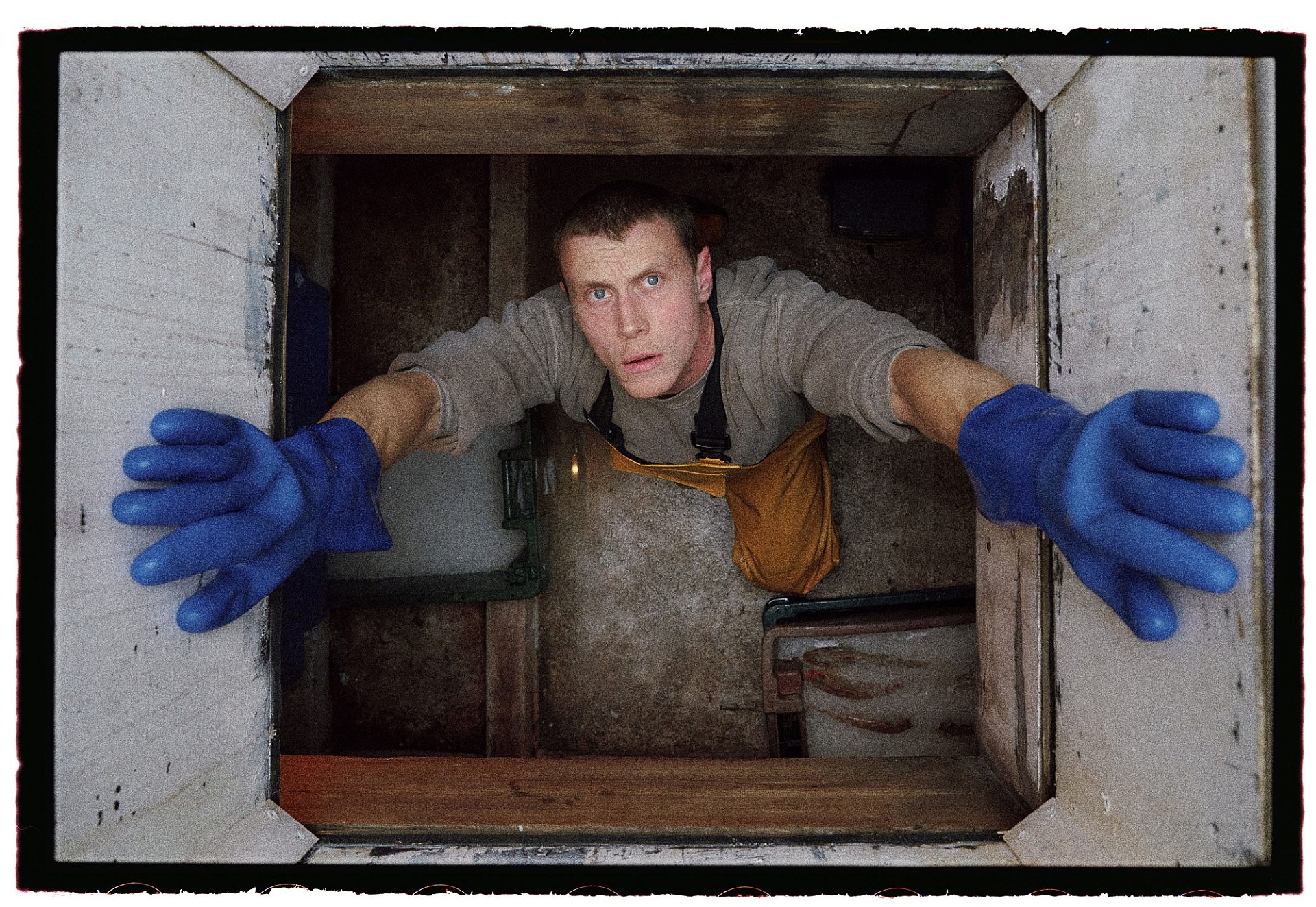
George MacKay on the titular boat in Mark Jenkin's ROSE OF NEVADA. Photo courtesy of 1-2 Special.
Jenkin views the scan on a 4K screen and cuts the film using low-res digital proxies in his studio and then again when the movie is locked. "I then go back to Atlantek [the Cornish post house] and work with Michael Todd, our post-production guy, where he conforms the film from the master DBX files, and then we grade it.
"I do a rough color grade as I'm editing," he adds, "because the retiming of the color will have a big effect on whether I use a shot or not. Michael's got my rough grade as a reference for when he's doing the final grade and we create look together. But, for me, ultimately, it's about striving for a Technicolor look with those saturated primary colors. There's no difference in the look of the film between 1993 and the present-day. I'm not into using the form to evoke a period of time, and that's partly why I like 16mm because it's so timeless."
However, what was important about the present-day setup was establishing the bleakness of the village and the contrast between Nick and Liam. Jenkin wanted Nick to have a loving relationship with his wife and child, so that when he loses them in the past, it becomes a more powerful tragedy. This is why a tender stroke of his wife's neck stands out as a moment of affection.
With Liam, who begins the film inexplicably running away from something, it was preferable to have no backstory, so that he has a better time accepting his wife and child in the past. "Callum and I had a discussion about it, and I told him that if he had a reason [for] what he was running from, that it was better that I didn't know," the director suggests.
Most of the scenes shot on the boat took place during the day in the inner harbor at St. Ives Bay. "And then when the tide was coming in," Jenkin says, "we headed out of the harbor while we could and filmed at sea for three or four hours, and then got back in before the harbor dried out. And so all the daytime stuff on the boat when they're being taught how to fish was really shot at sea. And it was difficult.
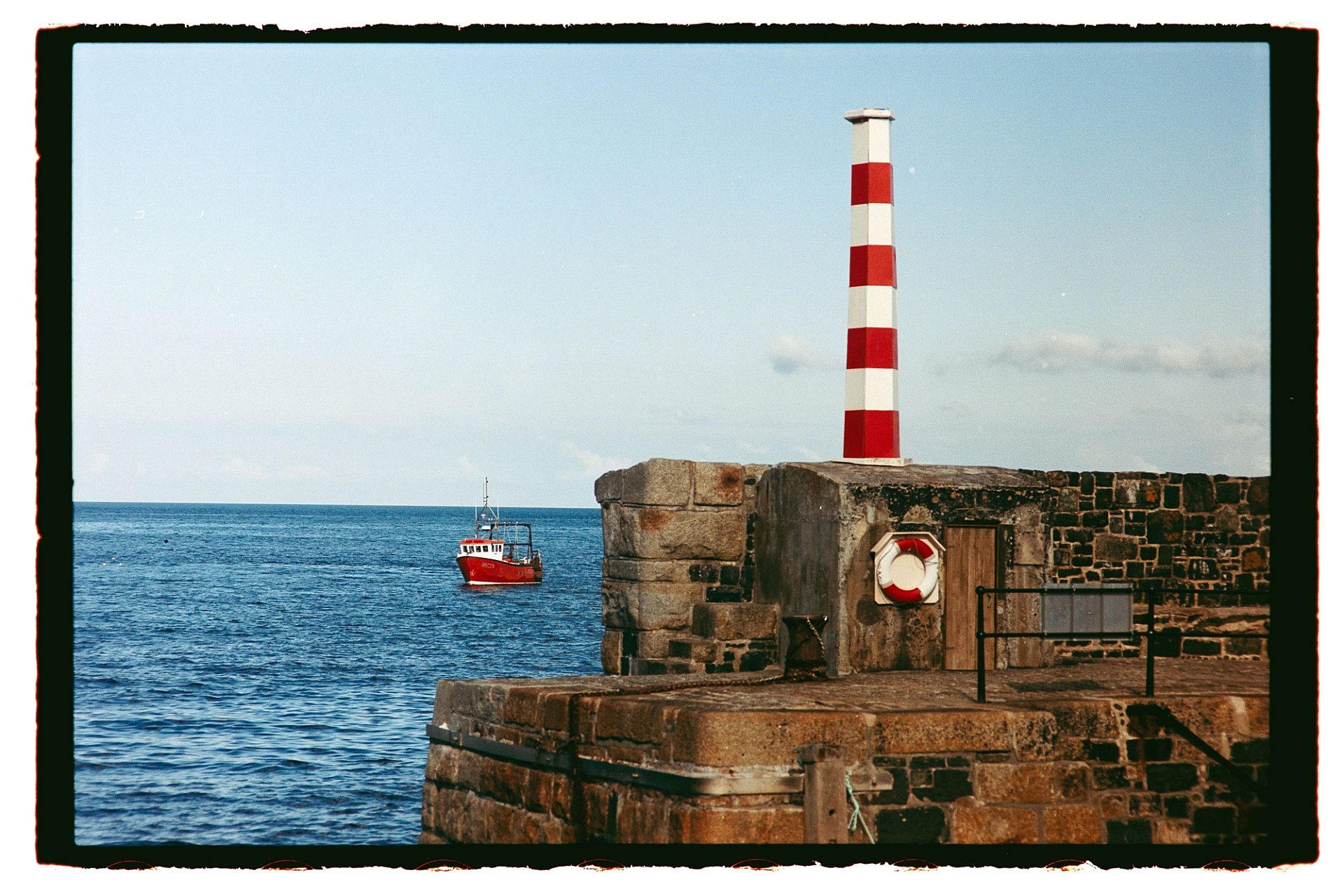
The titular boat in Mark Jenkin's ROSE OF NEVADA. Photo courtesy of 1-2 Special.
"We did a day where I was on a camera boat alongside, and we couldn't do a boat-to-boat transfer," he continues. "So the first time we went out, I was just in a camera boat filming wides of abstract shots of the sea and gulls in the sky. And then the next day we went out and I was on the actual boat with the actors. And it was tricky. I got pretty sick looking through the viewfinder. Or I was below deck with the diesel fumes and my head in a bag trying to change the film."
Meanwhile, the storm sequence at night was all done with the boat tied against the wall. It was all practical effects. "In those days, we had dump tanks and little hand-operated wave machines and water washers and rainmakers," Jenkin explains.
One of Jenkin's favorite locations was the local pub, both in the present day and in 1993. "I think a pub's a real barometer of a community," he says. "I mean, the film starts with a barometer on the wall, which wasn't in the script. But they put that up as a prop. I was just about to shoot a scene with Callum in the pub, and I needed to fire off a few feet at the beginning of the roll. So I just turned the camera around and filmed the barometer. And then later in the edit, not only was it compositionally really great, but the needle was pointing to unsettled. What a great image to begin the film with.
"I don't drink, but I go to the pub and everybody's there in our village," he adds. "It's a big thing. And it was really nice to explore that to the contrast of the [present day] empty pub. Because without people, a pub is just a shell of itself. And then the art department did a makeover and filled it with people. And, suddenly, it's this womb to return to. And you have all the characters in there with the jukebox and the pool table and people smoking and drinking. And I like the idea that there was people in there coming in and saying hello to each other."
In assessing Rose of Nevada as another memory film in his unofficial Cornish trilogy (that includes the black-and-white kitchen sink drama Bait and the horror period piece Enys Men), Jenkin calls it a progression.
"Whilst kind of doing the same thing, developing the way I work, it was a bigger cast, a bigger budget, and action scenes," Jenkin explains. I remember looking at the edit and watching it with the cast and crew for the first time and thinking: 'I'm an action movie director now.' I think we created something quite magical out of the storm sequence with very limited resources. So I think it's the end of something and the beginning of something else."
