How DP Gris Jordana shot the queer historical drama 'La Bola Negra' in 35mm for three different Spanish eras with naturalism and poetry
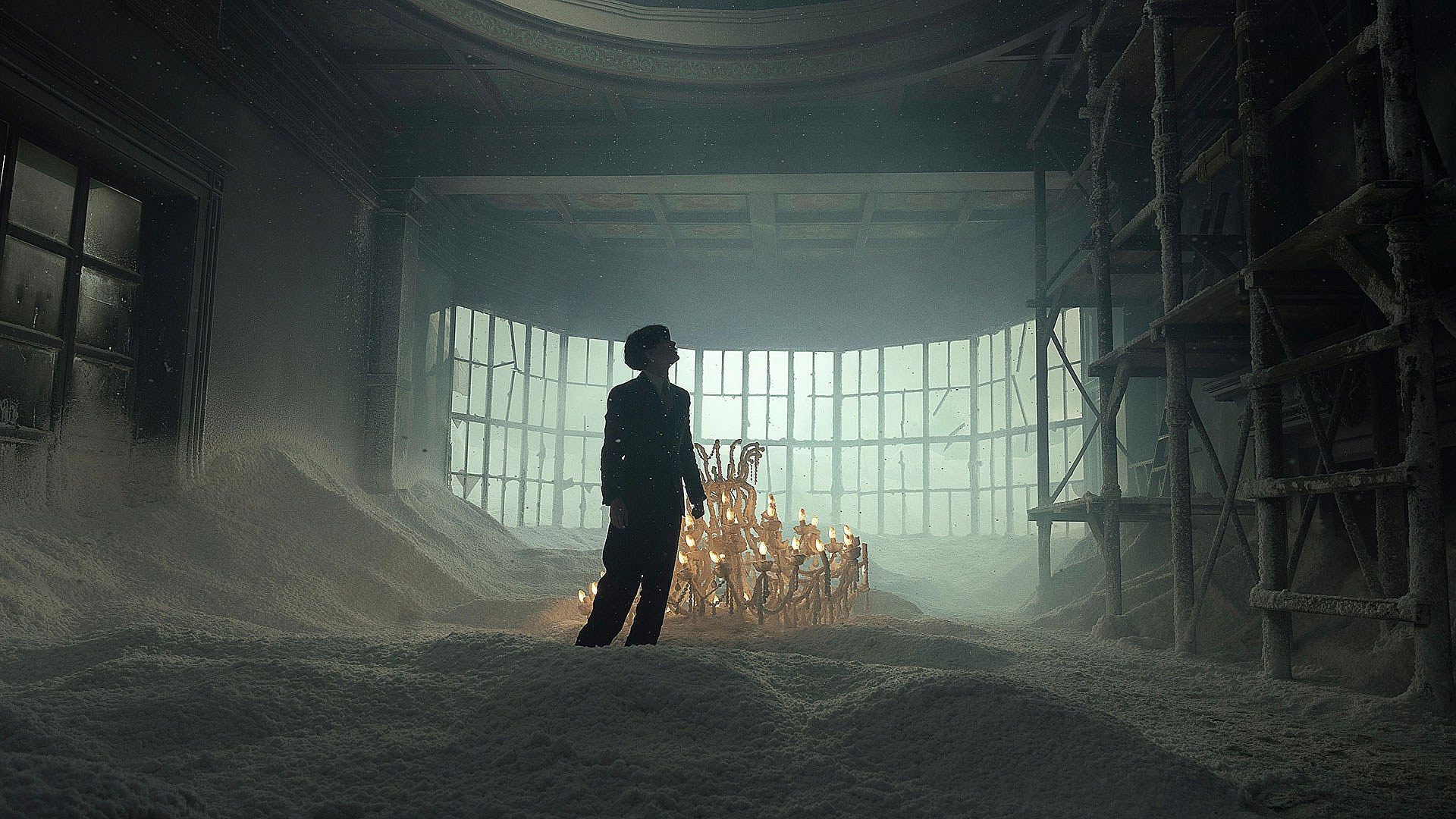
Carlos (Milo Quife) can't believe it's snowing in the casino during summer in LA BOLA NEGRA. Courtesy of Netflix.
After shooting their sprawling Spanish thriller series, La Mesias, on 16mm, it was time for directors Javier Calvo and Javier Ambrossi and cinematographer Gris Jordana to step up to 35mm for La Bola Negra, their grand movie that spans the 20th and 21st centuries of queer Spanish history.
Inspired by an unfinished play by legendary Spanish gay poet Federico García Lorca, who was murdered during the Spanish Civil War, La Bola Negra contains three inter-connected stories about three gay men:
- The 1932 fictional storyline, based on Lorca's play, follows young Carlos (Milo Quife), who is rejected for membership into his father's exclusive casino because of homosexual accusations.
- The 1937 storyline, inspired by the play, La piedra oscura, by Alberto Conejero (who co-scripted La Bola Negra with the directors), follows trumpeter-turned Nationalist soldier, Sebastián (Guitarricadelafuente), who bonds with prisoner-of-war Rafael (Miguel Bernardeau), Lorca’s real-life lover.
- The 2017 storyline follows Alberto (Carlos González), a grad student historian researching queer music of the 1920s, whose long-lost maternal grandfather unexpectedly passes away and leaves him a mysterious inheritance.
"This film could only be shot on 35mm," proclaims Jordana. "We needed everything that analog offers — the colors, the texture, the depth of field." They utilized the Arricam LT 3-perf camera with Panavision Primo lenses, with their soft, classic look, along with KODAK VISION3 250D 7207 and 500T 7219 Color Negative Films. They also shot 1.78:1: the original, 3-perf, 35mm full frame.
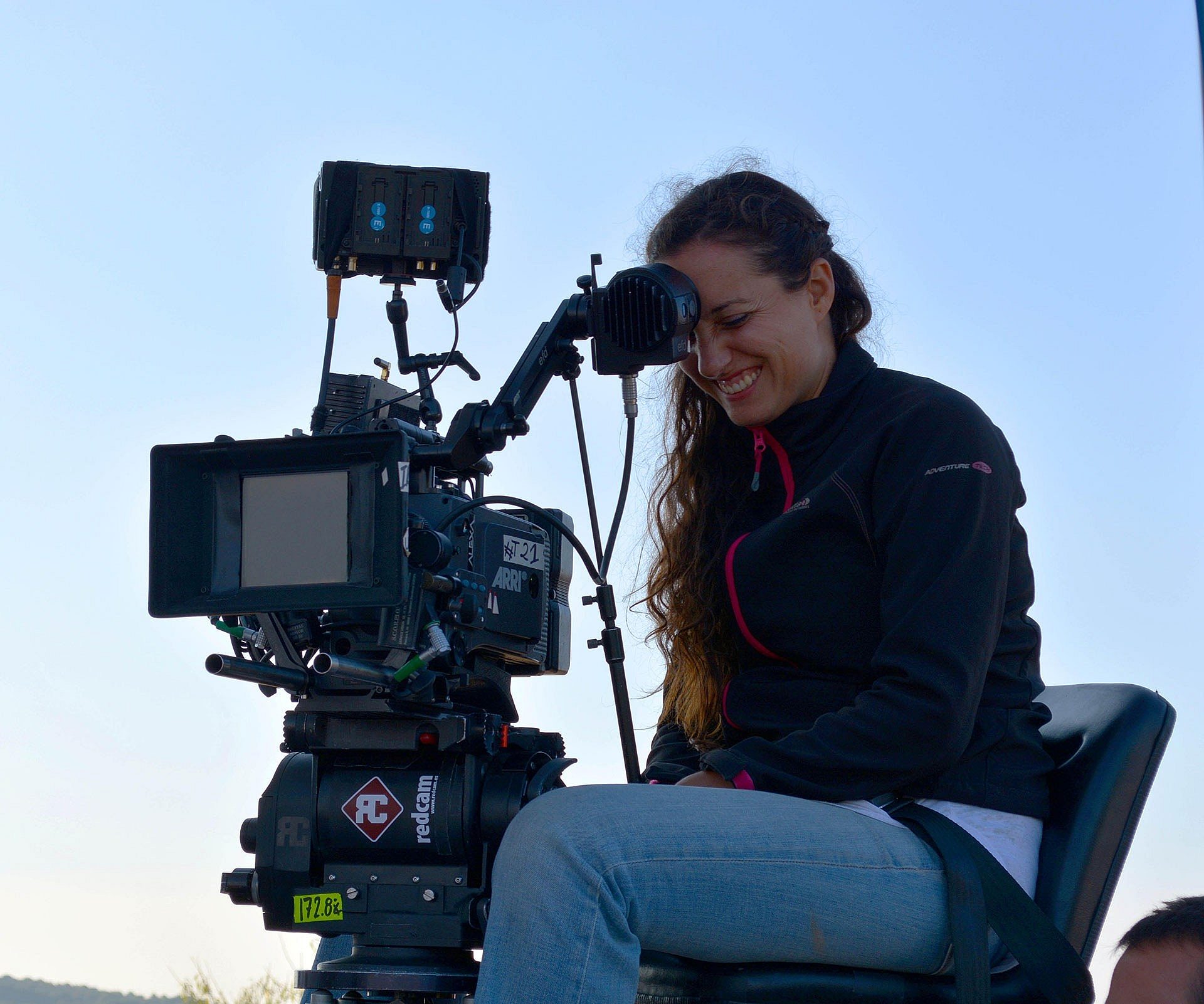
DP Gris Jordana on the set of LA BOLA NEGRA. Courtesy of Netflix.
They used 3-perf to enhance the texture of the grain and to make use of the entire negative. "Everything the negative provided was essential to imbuing the film with emotional weight and that blend of naturalism and poetry," Jordana adds. "For me, lighting was not tweaking every millimeter of the shot on a monitor (as one does with digital) but visualizing the light more abstractly in my mind. This results in a more natural look. The colors are perfect, and the texture inherent to analog film provides a plasticity that makes every image far more beautiful."
In terms of the look, they wanted it to be consistent throughout the three storylines because they were heavily interwoven. "We decided not to make any distinctions regarding processing, color correction, or exposure across the three storylines," she explains. "We wanted everything to flow as a single film. Instead, we chose to differentiate the eras through audiovisual language, mise-en-scène, and camera movement. I didn't use any non-standard processing, but I did overexpose the entire film by two-thirds of a stop to ensure I had enough latitude to work with during color grading."
For the 1932 story, the camera serves as a character in this fictional setting, roaming but getting close to Carlos with wide angles when he is still. For the Civil War story, the camera was more observational, very quiet, motivated by character movement inside the frame, utilizing 35mm and 40mm lenses. For the contemporary story, the camera follows the characters all the time, with telephoto lenses, which gave the actors more freedom in a documentary-like approach.
La Bola Negra begins with Carlos. His first grueling scene in the casino, where the vote is taken with the setting off of the loud white and black balls, was filmed on an elaborate set with sunlight streaming in. "The casino set was designed to utilize natural sunlight for backlighting throughout most of the day; we supplemented this with two HMI M90s positioned at the background windows," recalls Jordana. "We mounted an Arrimax on the ceiling, aiming it directly through the set's decorative light fixture to create moving reflections on Carlos' face.
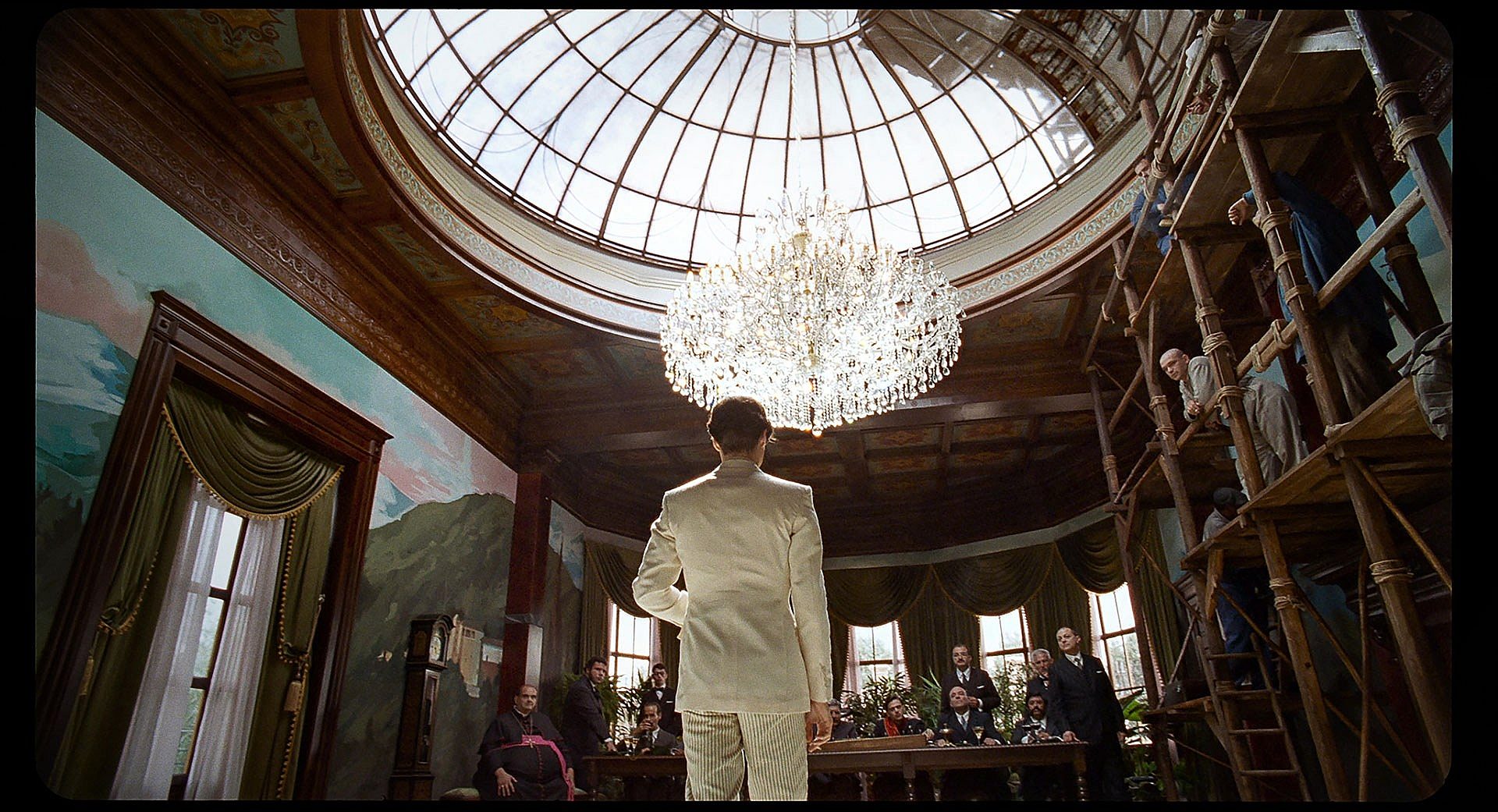
Carlos (Milo Quife) applies for membership at the exclusive casino in LA BOLA NEGRA. Courtesy of Netflix.
The skylight we built on the soundstage — designed to simulate the light from the dome later added via VFX — was massive. To control the ambient light filtering through it, my gaffer, Pablo Abad, constructed a square, mosaic-like grid structure that allowed us to remove sections or cover them with black material or diffusion. For the first casino sequence, I left the central square unfiltered so the Arrimax light would strike Carlos' face directly; I also overexposed that light by three or four stops because I wanted it to appear blinding."
Regarding the camera movement, it was a combination of angular shots that follow or move toward the character — as if the camera were stalking him — and very tight close-ups that lend the balls an importance that is almost crucial to the character's future. "This combination creates a sense of being cornered and pursued," she suggests.
An emotionally charged flamenco dance sequence with Carlos was shot as a oner in a taverna. "That was magic," Jordana recounts. "In the screenplay, he [merely] stands off his chair and goes to the bar. But then the [directors] told me, 'No, he will go dancing to the bar, and then someone will be playing and the kid will enter and it will become like a dance with choreography, so let's keep one day to shoot that.'
"I decided to light the scene with overhead lighting, leaving dark areas so that Milo could move in and out of the light during the choreography, and I added daylight coming through the windows to create a slight backlight in some areas. We had a plan for the entire dance, but when the time came, Peke Griffin, my camera operator, followed the entire scene, and when it was over, we realized that no further shots were needed; it was perfect just as Peke had improvised it in the first take. When he finished, we were clapping."
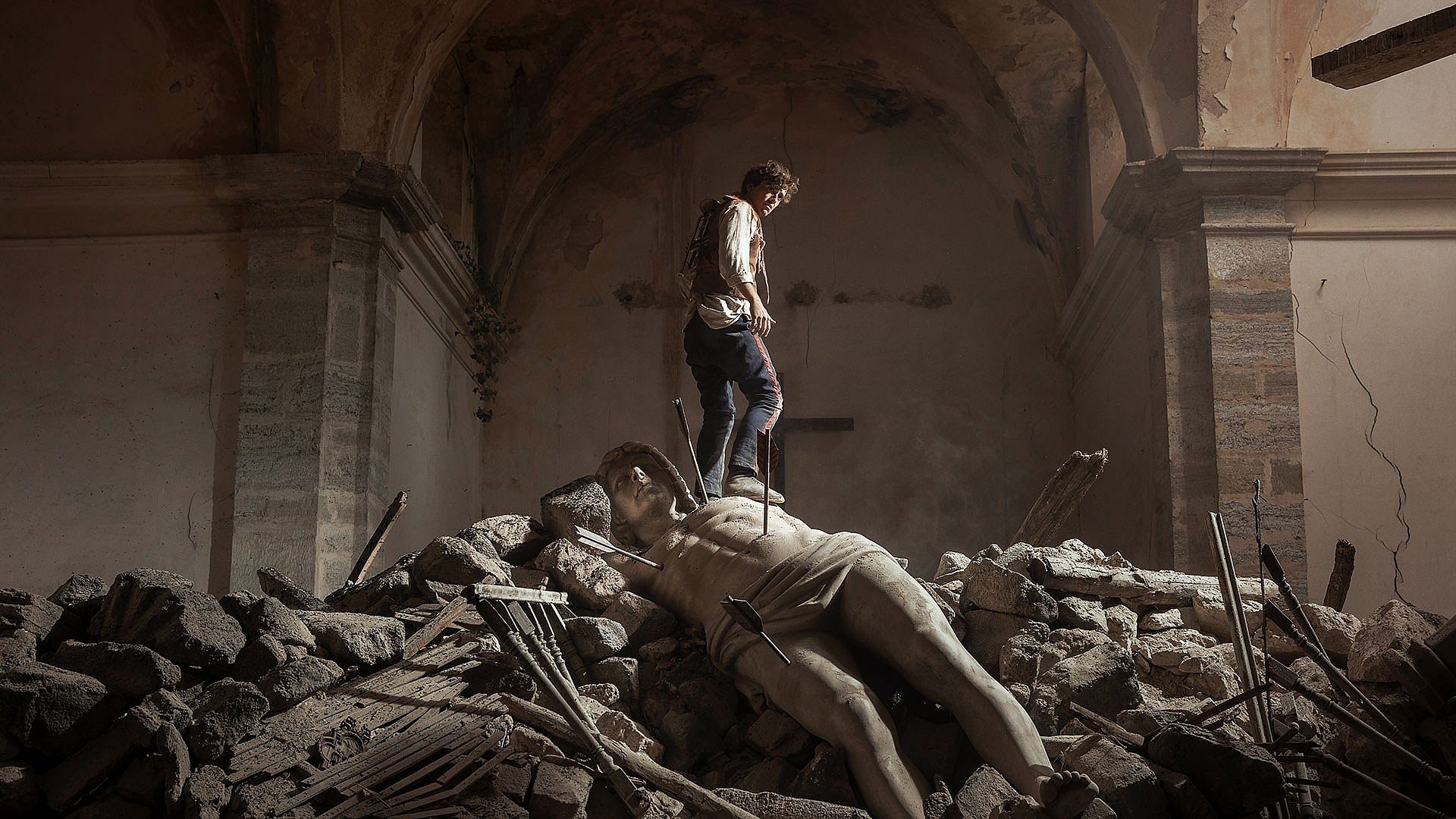
Nationalist soldier Sebastián (Guitarricadelafuente) stands on top of the ruins during the Spanish Civil War in LA BOLA NEGRA. Courtesy of Netflix.
By contrast, Carlos' return to the casino for a second vote is more fantastical, resulting in its destruction and overtaken with snow. "In this scene, the ceiling structure was almost entirely draped in black, with the central square covered in 50 percent grid cloth to diffuse the light from the Arrimax and create a more somber atmosphere," Jordana describes. "While the camera movement is not particularly expressive, the framing certainly is — especially regarding the casino partners who must deliver the verdict; these shots are inspired by paintings and filmed using highly expressive wide-angle lenses."
Meanwhile, the scenes between Sebastián and Rafael in the hospital convey a growing tenderness between them, yet the moments in the room were the most challenging of the entire film for the cinematographer. "We were shooting on real locations, we had to contend with fluctuating sunlight over our 10-hour shooting days," Jordana explains. "Some sequences were so long that they took three days to film, which made maintaining continuity even more difficult.
"In the sequence where Sebastian is bathing Rafael, we also had to create the impression that the scene began in sunshine, then turned cloudy, and finally started raining while they were talking," she continues. "We positioned two cranes outside the windows: they started with direct light from four HMI M90s for the initial scenes, switched to bounced light for the cloudy scenes, and used tungsten Maxi-Brutes blended with natural ambient light for the sunrise scene where Sebastian approaches the sleeping Rafael. We carefully organized each day to use the sun's natural path to our advantage, scheduling shots facing the windows — to avoid overexposing the exterior — for specific times of day, while reserving other times for shots where no windows were visible."
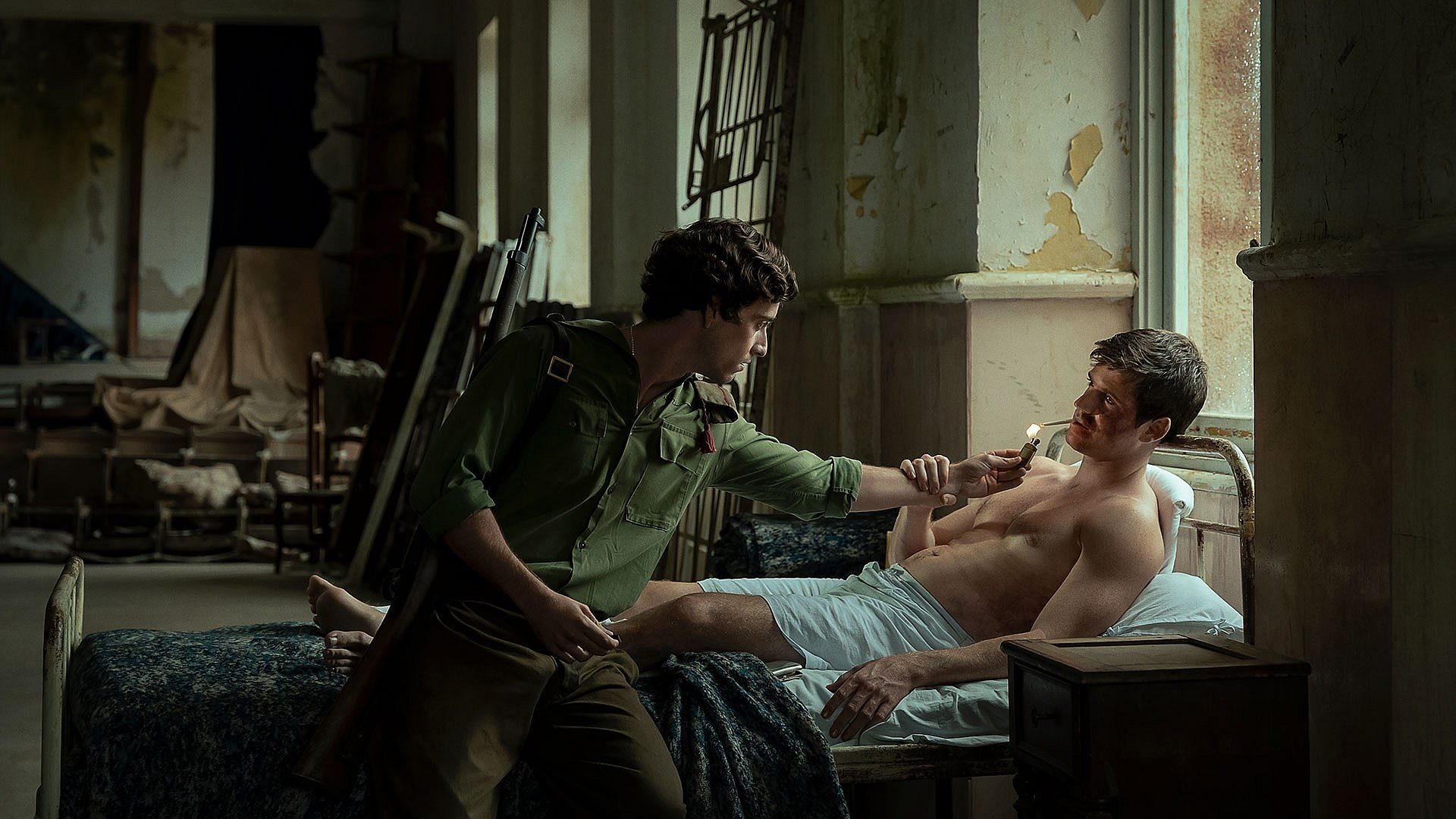
L-R: Sebastián (Guitarricadelafuente) bonds with prisoner-of-war Rafael (Miguel Bernardeau) during the Spanish Civil War in LA BOLA NEGRA. Courtesy of Netflix.
Two musical numbers featuring cabaret singer Nené (Penélope Cruz) also grace the 1937 storyline. In the first, "Las tardes del Ritz," Nené sings on stage and the light source was positioned far away with heavy diffusion, using two lights at 45-degree angles, alternating them based on the camera axis. For the audience, they used 4300K spacelights to simulate a soft ambient glow, especially when she sings among the crowd.
"We supplemented this with period-appropriate practicals — specifically footlights placed on the floor," Jordana says, "as was customary at the time — to fill out the stage lighting. At the back of the stage — without spilling onto Penelope — we distributed hard overhead lights to illuminate the set and the beautiful backdrop created by Judit, our set decorator."
For the "Batallón de Modistillas" (Seamstress Battalion) number, they used a Scorpio head to execute the movement from Sebastian turning around to Penélope appearing atop the tank; they then switched to a Steadicam to follow her once she climbed down.
"Regarding lighting, in addition to the base spacelights, we rigged a China ball with a 2kW bulb onto the Scorpio head itself so it would track Penélope alongside the camera," Jordana adds. "We also dressed two electricians as extras and positioned them on scaffolding where vintage 2kW quartz fixtures were mounted — which the lighting and art departments had retrofitted with 5kW bulbs — so they could manually pan the lights to follow the battalion's movement, making it look like part of the show itself."
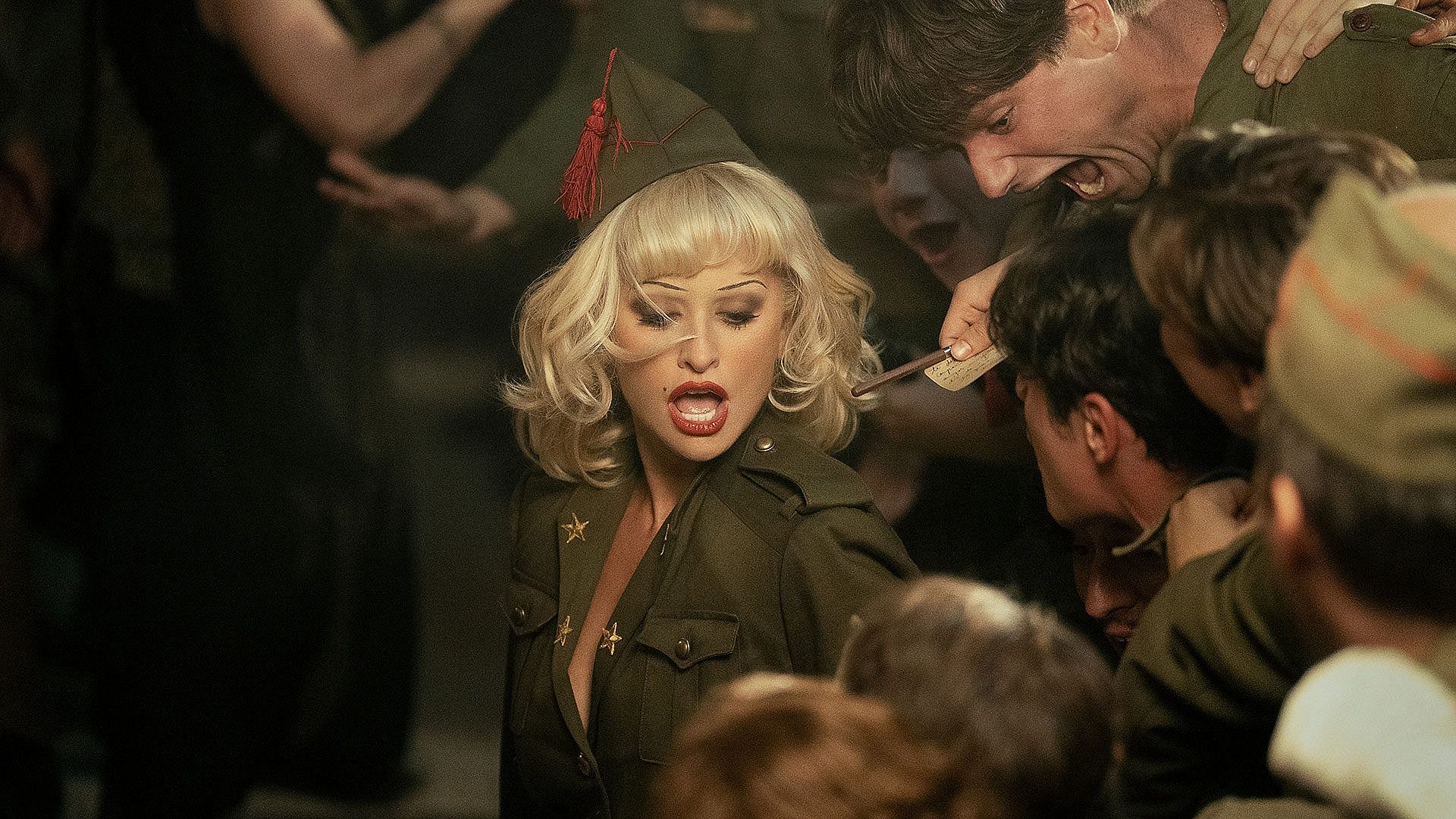
Cabaret singer Nené (Penélope Cruz) performs "Batallón de Modistillas" during the Spanish Civil War segment of LA BOLA NEGRA. Courtesy of Netflix.
There's even a black-and-white flashback sequence between Rafael and Lorca (Alberto Cortés). They used KODAK TRI-X 7266 stock and had specific lighting references in mind for those images. "It was the only time we saw Lorca, and we didn't want it to differ from the three other periods," Jordana recalls. "It was meant to be a kind of memory — a final thought directed at Rafael’s love. The camera work is very classical; I overexposed the negative to bring out more grain, using very powerful light sources and steering away from naturalism."
When it came to the contemporary story with Alberto, the scenes in Madrid were like stepping out onto the street in La Latina for all the city's inhabitants to recognize it as their own without embellishment. "I wanted [the lighting] to feel very natural, almost as if it weren't lit at all," Jordana suggests.
"In the scenes featuring Alberto and his mother [Lola Dueñas], our priority was to give the actors freedom of movement," she continues. "For instance, at the house in Cercedilla, we would position the two cameras at complementary angles and let the actors perform until they moved out of frame; then we would cut and reposition for the next segment."
Returning to the importance of shooting La Bola Negra on 35mm, Jordana offers: "With digital, you are constantly fighting the format: using filters to add texture, using smoke, vintage lenses to break up the image's harshness, manipulating light quality to soften it, and using LUTs to make the colors look natural. To me, 35mm is a much nobler medium; with the right lighting direction, the magic simply happens. It transforms a harsh light — one I would never use for digital — into something truly beautiful; not to mention daytime exteriors, which I simply stop lighting altogether if I’m shooting on film."
