How Adam Newport-Berra shot Jordan Firstman's 'Club Kid' in 35mm as both a gritty and colorful father-son story
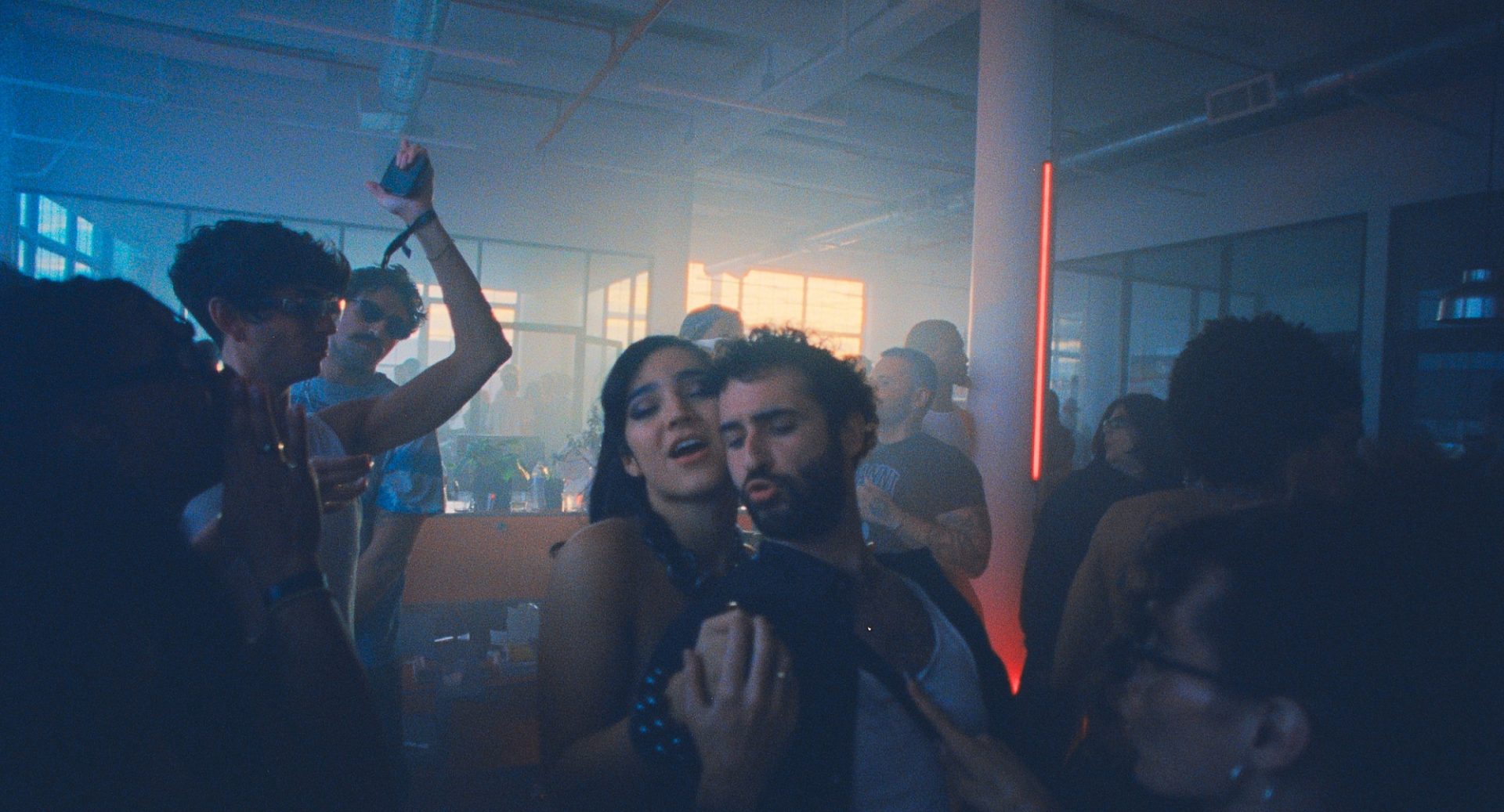
Peter (portrayed by director Jordan Firstman) is a hard-partying club promoter at an afterparty in CLUB KID. Photo courtesy of A24.
Club Kid, the feature directorial debut of actor-comedian-writer Jordan Firstman, captures the hedonism of the New York City queer club scene in 2016 and how it's transitioned to a blander vibe in 2026. Shot by cinematographer Adam Newport-Berra (The Invite, Splitsville) in 35mm, the movie captures a gritty and textured nighttime aesthetic, as well as a more colorful and naturalistic daytime look.
The story, though, is a fresh coming-of-age twist. It follows Peter (Firstman), a hard-partying club promoter forced to grow up after learning that he has a 10-year-old son, Arlo (Reggie Absolom), to take care of on his own.
"I just loved how funny and authentic the script was, and how it was able to capture a really unique culture in New York City, but also be an intimate family drama," Newport-Berra explains. "So, for me, it was about finding that balance of doing something really interesting with the camera work and making sure it felt genuine."
Firstman originally wanted to shoot 16mm before hiring the cinematographer, who convinced him that 35mm would give more shape and depth to the world and make it feel more epic. "I also knew that the movie would live in a lot of close-ups, and I think shooting on 35mm gives me more roundness and intimacy to people's faces. We figured out a way to afford it."
What excited Newport-Berra about the project was building and shooting all the different parties, capturing available light and natural light, and shooting in striking New York interiors.
"We were always trying to jump between a darker, grimier, fun New York, and then a more beautiful and human version of New York," he adds.
Newport-Berra shot with the Panavision Millennium XL2 camera, working with Dan Sasaki, the company's Senior Vice President of Optical Engineering, on crafting custom ultra-speed lenses that could get really close focus, open up very wide, and shoot in extremely low light.
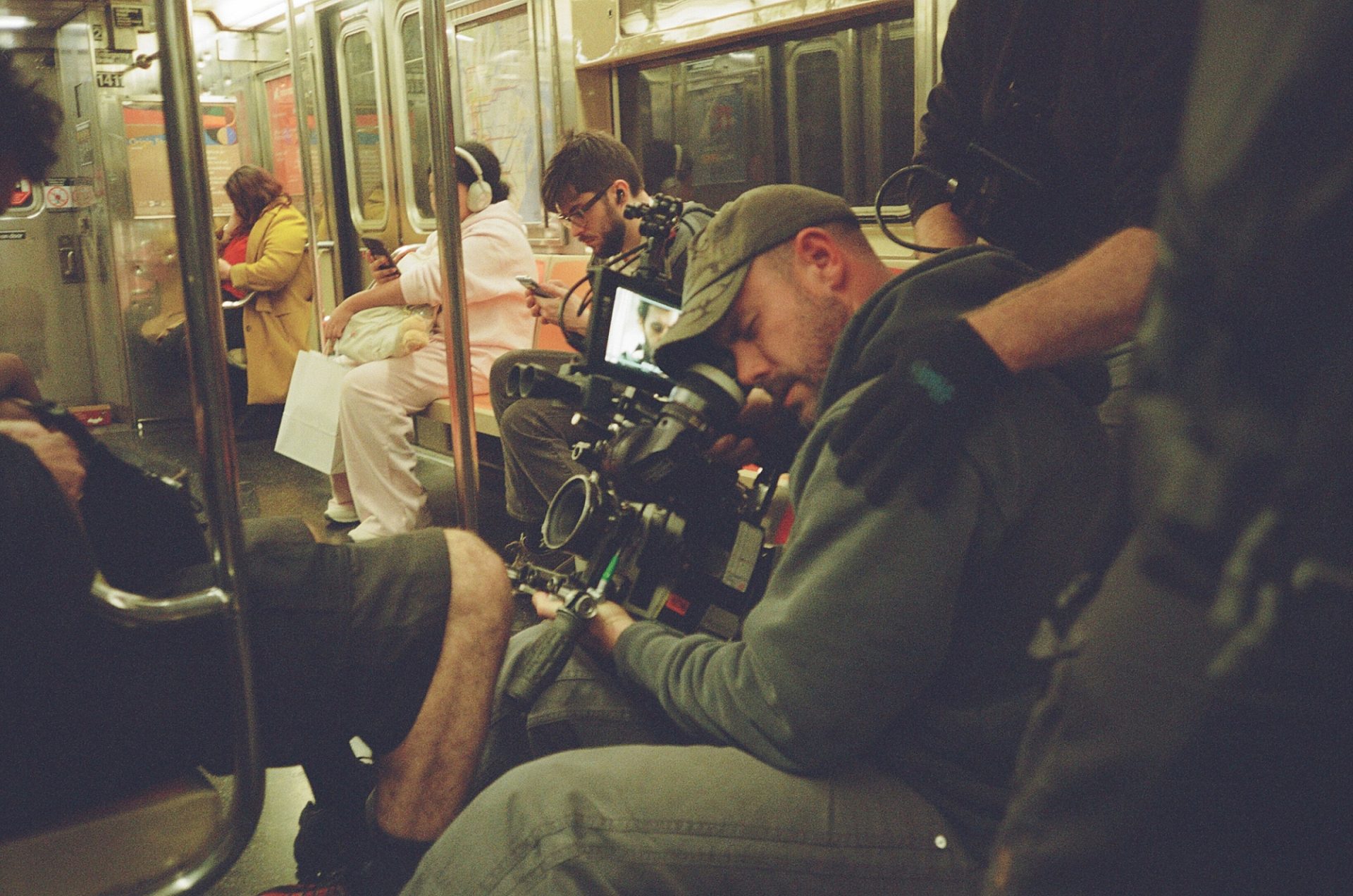
Cinematographer Adam Newport-Berra on location in New York City in CLUB KID. Photo courtesy of A24.
He also chose KODAK VISION3 200T 5213 and 500T 5219 Color Negative Film stocks. The former he used for daylight and the latter for all the night scenes. "I really like the 200T stock," Newport-Berra suggests, "because it has a little bit more color and contrast, so there's interesting things that happen with color and with light. And I love the grain structure of it.
"We used the 500T because we often were working with real party lighting or when we did the parties ourselves, we didn't have a huge lighting package, and I wanted to have as much flexibility as possible," he continues. "And we also pushed that a stop so that I could get as much information out of the negative as possible."
Club Kid opens with a tour de force prologue in 2016, utilizing the grainy and grimy style to evoke the aura of William Friedkin's Cruising (1980), according to Newport-Berra. It kicks off with a 10-minute Uber ride on the way to the underground club. The 360-degree oner boasts a dynamic, spinning camera that moves inside and outside the vehicle.
"That shot was something that Jordan dreamed up and pitched early to me in prep," Newport-Berra recalls. What was challenging was that we were working on a limited budget and a lot of time constraints. So I needed to figure out a solution that was simple and cost-effective. I didn't have the budget to light up any of the streets, and I think we still probably spent half of our grip box budget on that shot.
"We basically drove over 20 city blocks, at the whim of whatever was happening on the street," he continues. "And then we had minimal light tubes outside the car to add a little bit of lighting coming in. I had to rely on the 500T and pushing it a stop to know that I could have a dense negative. I wanted information in the car and outside the car to really feel the city but not make it feel lit, and I think that scene is such a testament to what film can do."
First, they had to find a vehicle that could fit the camera in that console area to spin around. With that achieved, given the limited space, they ended up using the Arri 235, which is the smallest of the 35mm cameras. In addition, they utilized 200-foot loads of film to avoid hitting actor's faces if it was spinning around.
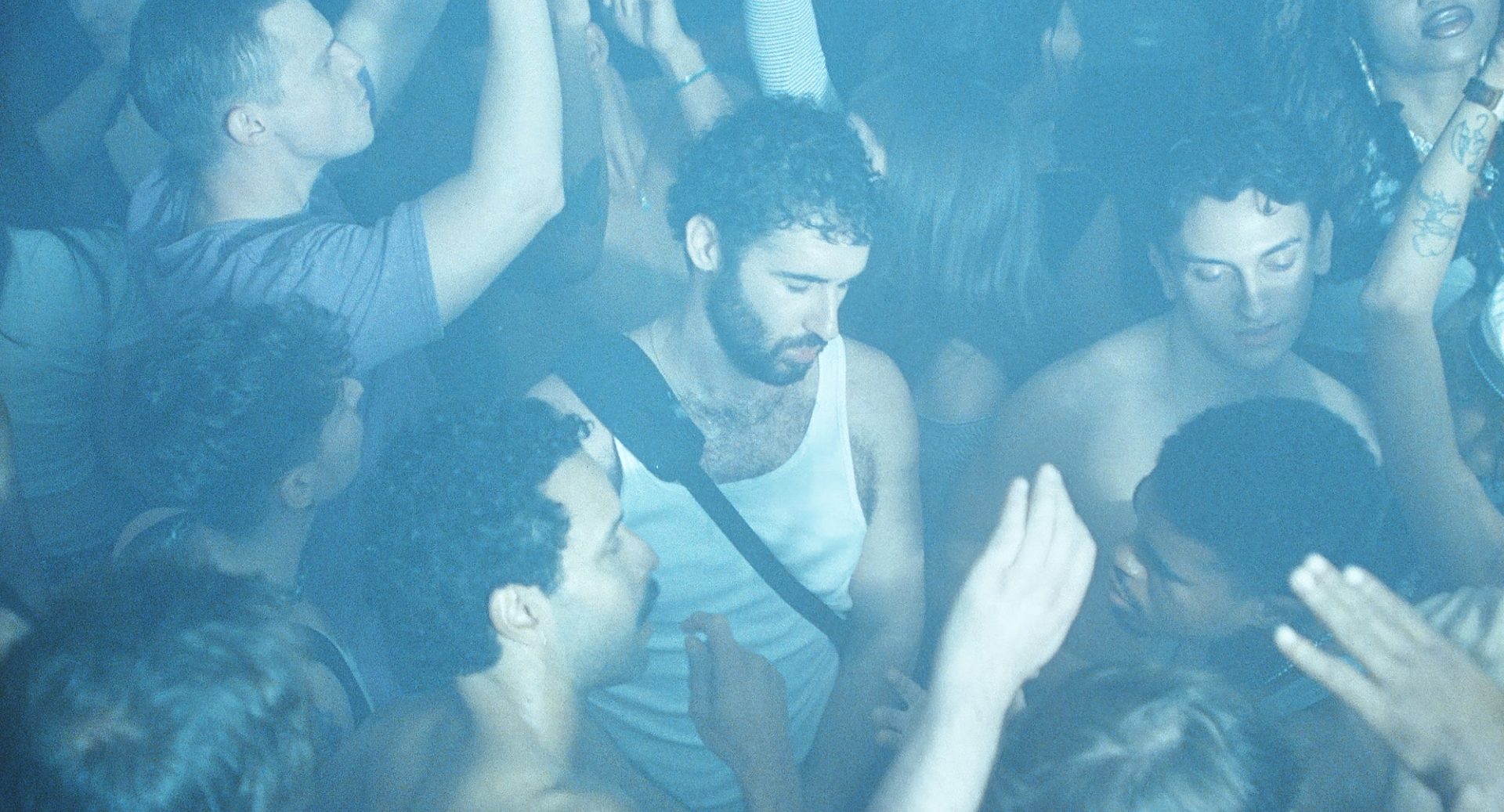
Peter (portrayed by director Jordan Firstman) is a hard-partying club promoter at Club Labor in CLUB KID. Photo courtesy of A24.
"Dan Sasaki designed a close-focus lens that could actually focus on the driver and Jordan, who were very close to the camera," Newport-Berra explains. "On top of that, once we built that rig, we realized it was still too big to spin in that space, and it would end up obstructing the driver's view or hitting Jordan in the face. We then rigged the camera underslung on a remote slider through the sunroof, and that slider actually moved opposite the camera's pan, so if the camera was panning towards the driver, it would slide away from the driver, and then vice versa, so the camera could get a shot no matter where it was and being operated remotely from us via a follow car."
The Uber ride transitions to the first party, a crowded, celebratory bacchanal, which was shot at the Market Hotel in Bushwick to stand in for the fictional Club Labor. "That scene was obviously crucial, and we talked a lot about it during prep, and it was the last part of the New York unit," says Newport-Berra.
"Jordan always wanted that scene to feel very optimistic, positive, inclusive, and welcoming because what he was struggling with as a character and as a person was that a lot of the parties in that scene these days are not that," he continues. "They're a little darker, a bit more haunted. So we used softer colors, like lavenders and pinks. We had a much more diverse range of people and wardrobe. The camera was a lot more freed and a lot more wild in a lot of ways. We used Steadicam from the beginning of that scene. Then a lot of it was just me with the camera on my shoulder in there partying with them and literally running around with Jordan at my side. He would be like: 'Shoot that, run over here,' and would just create a scene between people and a lot of them were friends of his or friends of friends or people from the community."
When it came to shooting daylight scenes, Newport-Berra tried to expose as normally as possible, but sometimes he had to underexpose because it was fall in New York. This happened with one particular scene when Arlo first gets dropped off at Peter's exquisite apartment with 180-degree windows. It was partially cloudy and it was a long day, and there wasn't enough light when they started. The cinematographer dropped it two stops but was able to bring it up in the DI, which brought out really nice grain structure.
(L-R) Arlo (Reggie Absolom) and Peter (portrayed by director Jordan Firstman) start bonding togetherin CLUB KID. Photo courtesy of A24.
"This is like a 10-page scene, and the sun rises on one side and sets on the other, and part way through the morning the sun came out and blasted through one side of the windows," he recalls. "And then when we broke for lunch and came back, all of a sudden, the sun's coming through another set of windows, and we kept shooting and the sun's always changing. And we were running 1,000-foot mags handheld just so we could run for 10 minutes straight.
"So I ran the stock through every lighting situation," he adds, "and by the end of the day I was terrified that I was going to get back dailies that we'd never be able to match. But we did. The beautiful thing about film is how dynamic it is and how much latitude it has, and we spent half a day working on the negative and on the scans and just color balancing it to get the brightness balanced out. It was really able to hold the highlights, and we brought out shadows where we needed to, and it looks totally seamless."
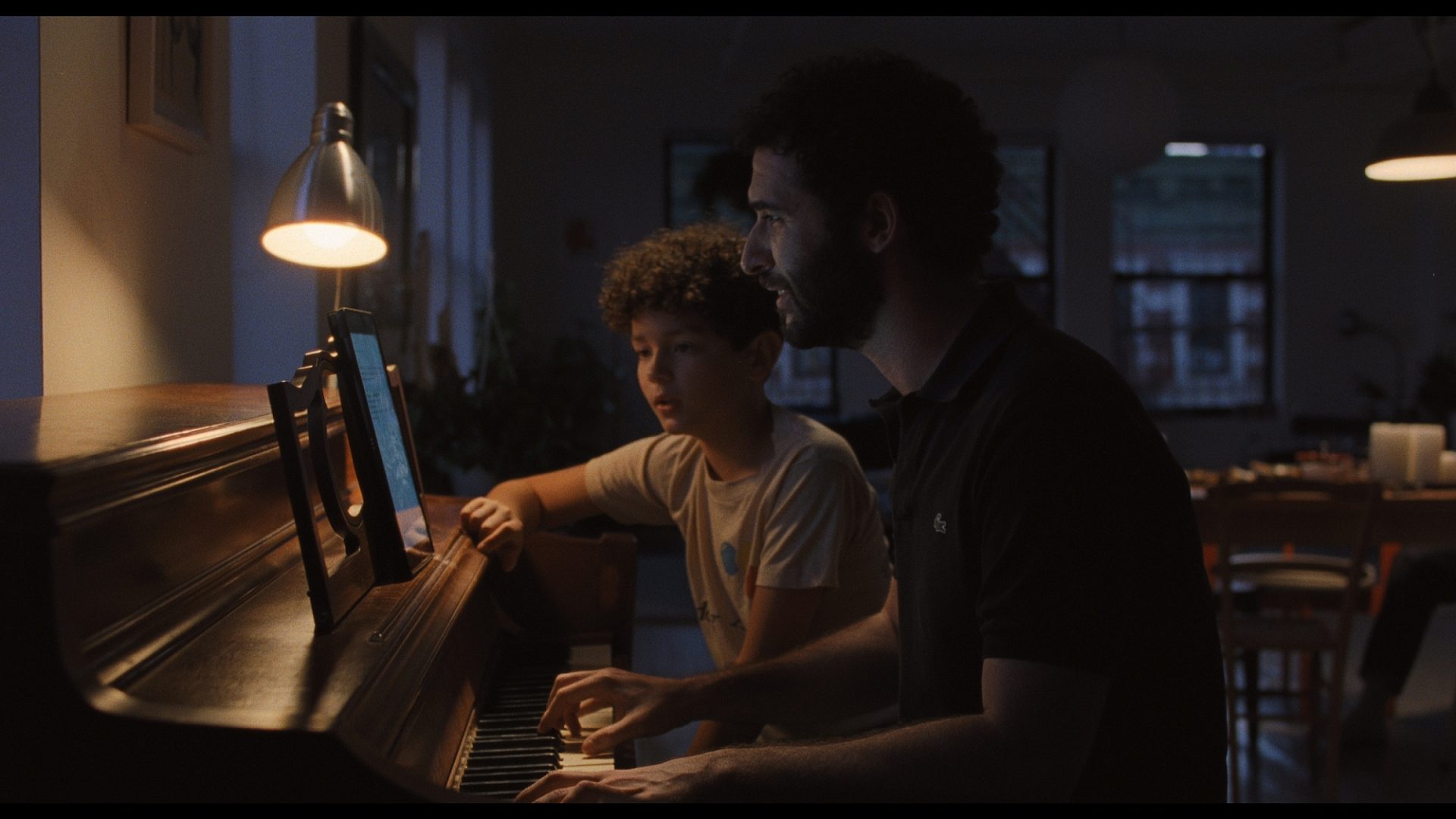
Meanwhile, one of Newport-Berra's favorite scenes is where father and son play the piano together ("Thoroughfare" by Ethel Cain), which is an homage to Paul Mazursky's An Unmarried Woman (1978). This is a moment for the viewer to revel in their bonding. "And to also zoom out, literally, to see them as two people thriving in New York City for the first time," he suggests.
"We had been shooting in the apartment and were itching to get outside," he continues. "We kept talking about how we could potentially see the apartment from another building, and we finally found a rooftop to get a great shot of the apartment at dusk, which meant we had 10 minutes to shoot it, the perfect length.
"We also knew we wanted to be inside with them. There was no way that scene was going to work with just a zoom out. We needed to see their faces and start it, and we decided that the scene could play as two shots at the same time. So the whole time that the camera is zooming out, there's a camera on a dolly that's just outside on the edge of the frame, pulling back at the same speed.
"We were able to synchronize that really beautifully," adds Newport-Berra, "and we rehearsed it a few times while the sun was still out to make sure we had the timing. So that right when dusk hit, we really only had a couple takes of this scene. And by the time we were able to roll on it, we were ready, and it turned out magically."